describe the end behavior of the function x→∞,f(x)→2 and x→−∞, f(x)→∞ x→∞, f(x)→∞ and x→−∞, f(x)→∞ x→∞…
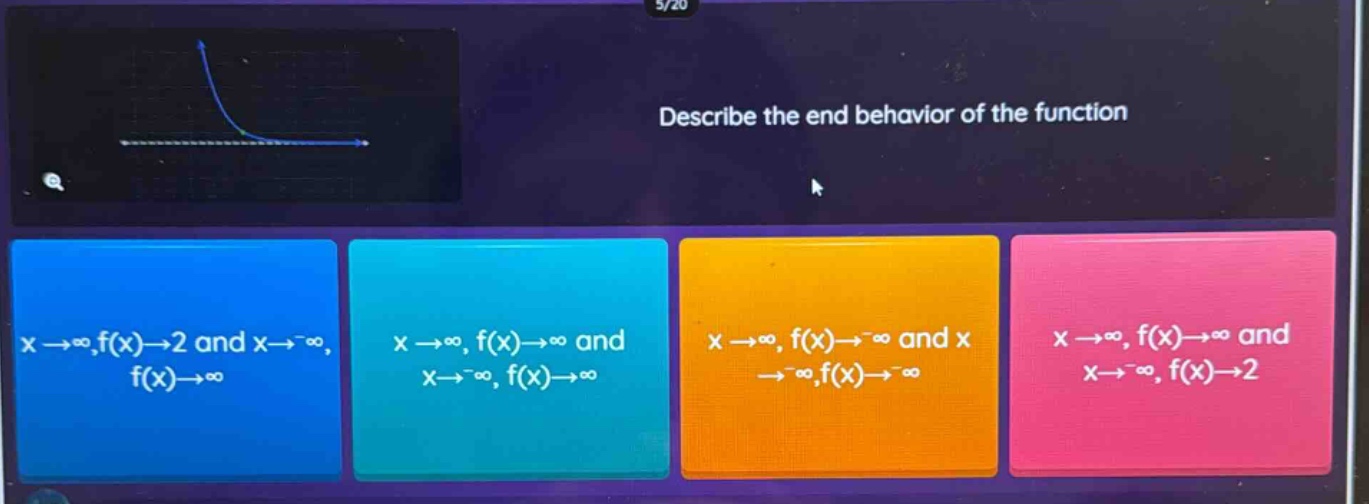
describe the end behavior of the function x→∞,f(x)→2 and x→−∞, f(x)→∞ x→∞, f(x)→∞ and x→−∞, f(x)→∞ x→∞, f(x)→−∞ and x→−∞,f(x)→−∞ x→∞, f(x)→∞ and x→−∞, f(x)→2
Answer
Explanation:
Step1: Analyze right - hand end behavior
As (x\to\infty), we look at the trend of the function on the right - hand side of the graph. If the function approaches a horizontal line (y = L), then (\lim_{x\to\infty}f(x)=L). If it goes up or down without bound, (\lim_{x\to\infty}f(x)=\pm\infty).
Step2: Analyze left - hand end behavior
As (x\to-\infty), we look at the trend of the function on the left - hand side of the graph. If the function approaches a horizontal line (y = L), then (\lim_{x\to-\infty}f(x)=L). If it goes up or down without bound, (\lim_{x\to-\infty}f(x)=\pm\infty).
Step3: Match with options
By observing the graph, as (x\to\infty), (f(x)\to2) and as (x\to-\infty), (f(x)\to\infty).
Answer:
x →∞,f(x)→2 and x→ -∞, f(x)→∞