2 describe the end behavior of the function graphed below. a as x→−∞, f(x)→−∞; as x→+∞, f(x)→−∞ b as x→−∞…
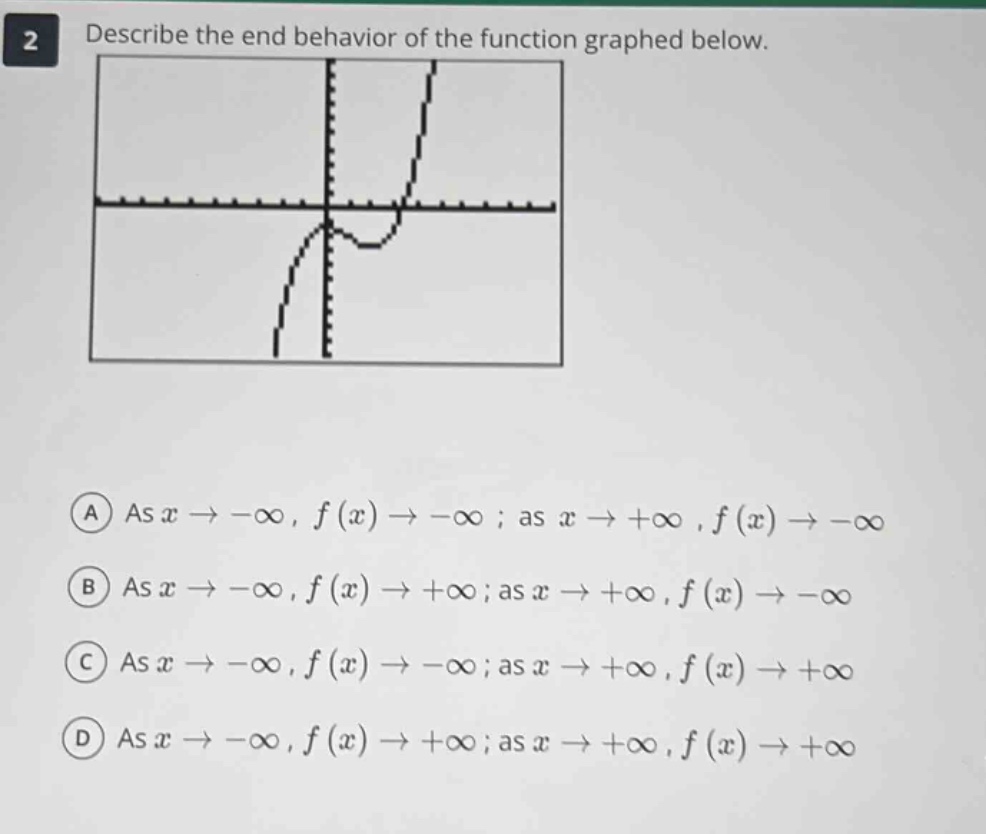
2 describe the end behavior of the function graphed below. a as x→−∞, f(x)→−∞; as x→+∞, f(x)→−∞ b as x→−∞, f(x)→+∞; as x→+∞, f(x)→−∞ c as x→−∞, f(x)→−∞; as x→+∞, f(x)→+∞ d as x→−∞, f(x)→+∞; as x→+∞, f(x)→+∞
Answer
Explanation:
Step1: Analyze left - hand end behavior
As (x) approaches (-\infty) (moves to the left on the (x) - axis), we observe the graph going downwards. So, (f(x)\to-\infty) as (x\to-\infty).
Step2: Analyze right - hand end behavior
As (x) approaches (+\infty) (moves to the right on the (x) - axis), we see the graph going upwards. So, (f(x)\to+\infty) as (x\to+\infty).
Answer:
C. As (x\to-\infty), (f(x)\to-\infty); as (x\to+\infty), (f(x)\to+\infty)