describe the graph of f(x) by selecting the correct statement. (1 point) the average rate of change is…
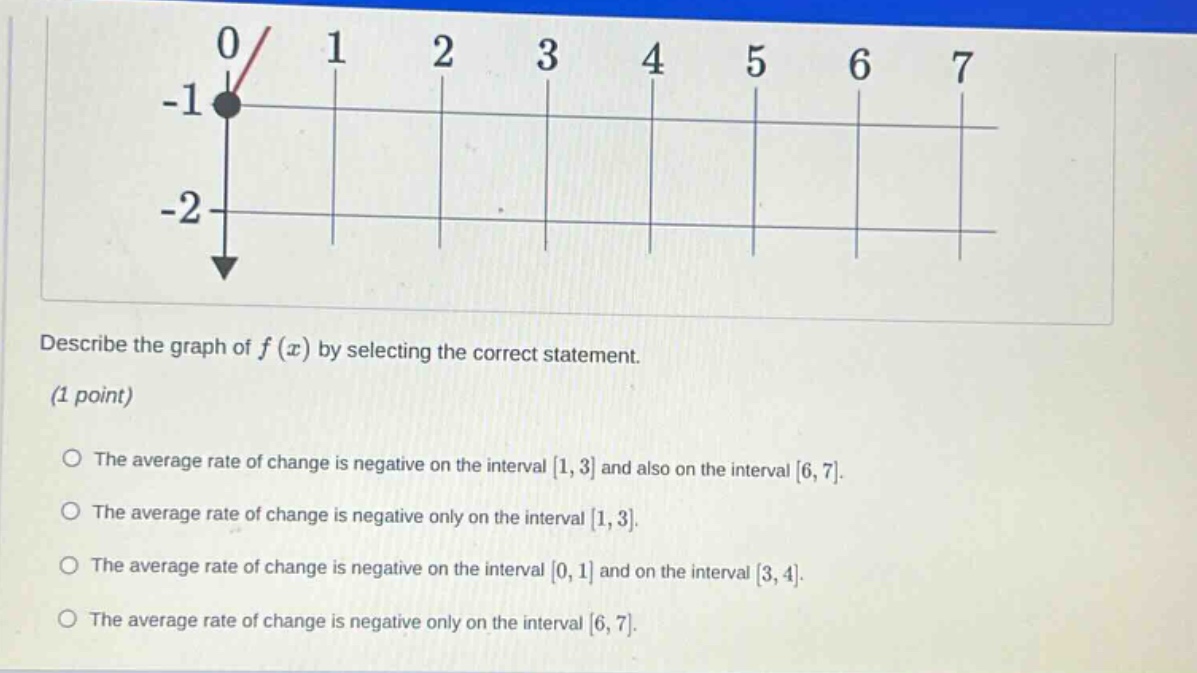
describe the graph of f(x) by selecting the correct statement. (1 point) the average rate of change is negative on the interval 1,3 and also on the interval 6,7. the average rate of change is negative only on the interval 1,3. the average rate of change is negative on the interval 0,1 and on the interval 3,4. the average rate of change is negative only on the interval 6,7.
Answer
Explanation:
Step1: Definir tasa de cambio promedio
La tasa de cambio promedio de una función $y = f(x)$ en el intervalo $[a,b]$ está dada por $\frac{f(b)-f(a)}{b - a}$. Si $\frac{f(b)-f(a)}{b - a}<0$, la tasa de cambio promedio es negativa.
Step2: Analizar intervalo [1,3]
Supongamos que para $x = 1$ y $x = 3$, si $f(3)<f(1)$ (lo que significa que la función está decreciendo en el intervalo), entonces $\frac{f(3)-f(1)}{3 - 1}<0$.
Step3: Analizar intervalo [6,7]
Si $f(7)<f(6)$ en el intervalo $[6,7]$, entonces $\frac{f(7)-f(6)}{7 - 6}<0$.
Step4: Analizar otros intervalos
Para el intervalo $[0,1]$, si $f(1)>f(0)$ la tasa de cambio promedio es positiva. Para el intervalo $[3,4]$, si $f(4)>f(3)$ la tasa de cambio promedio es positiva.
Answer:
The average rate of change is negative on the interval $[1,3]$ and also on the interval $[6,7]$.