describe the long run behavior of f(x)=x^6 as x→−∞, f(x)→? as x→∞, f(x)→?
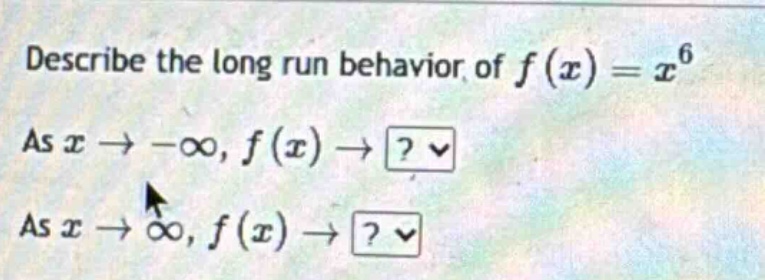
describe the long run behavior of f(x)=x^6 as x→−∞, f(x)→? as x→∞, f(x)→?
Answer
Explanation:
Step1: Analyze negative - infinity behavior
For any non - zero real number (x), when (x\to-\infty), and the function is (f(x)=x^{6}). Since the exponent (n = 6) is even, ((-x)^{6}=x^{6}). As (x) gets more and more negative (i.e., (x\to-\infty)), (f(x)=x^{6}\to\infty).
Step2: Analyze positive - infinity behavior
When (x\to\infty), for the function (f(x)=x^{6}), as (x) gets larger and larger (i.e., (x) is a large positive number), (x^{6}) also gets larger and larger. So (f(x)\to\infty) as (x\to\infty).
Answer:
As (x\to-\infty), (f(x)\to\infty); As (x\to\infty), (f(x)\to\infty)