describe the possible end behavior of a polynomial. choose the correct answer below. o a. either lim f(x)=…
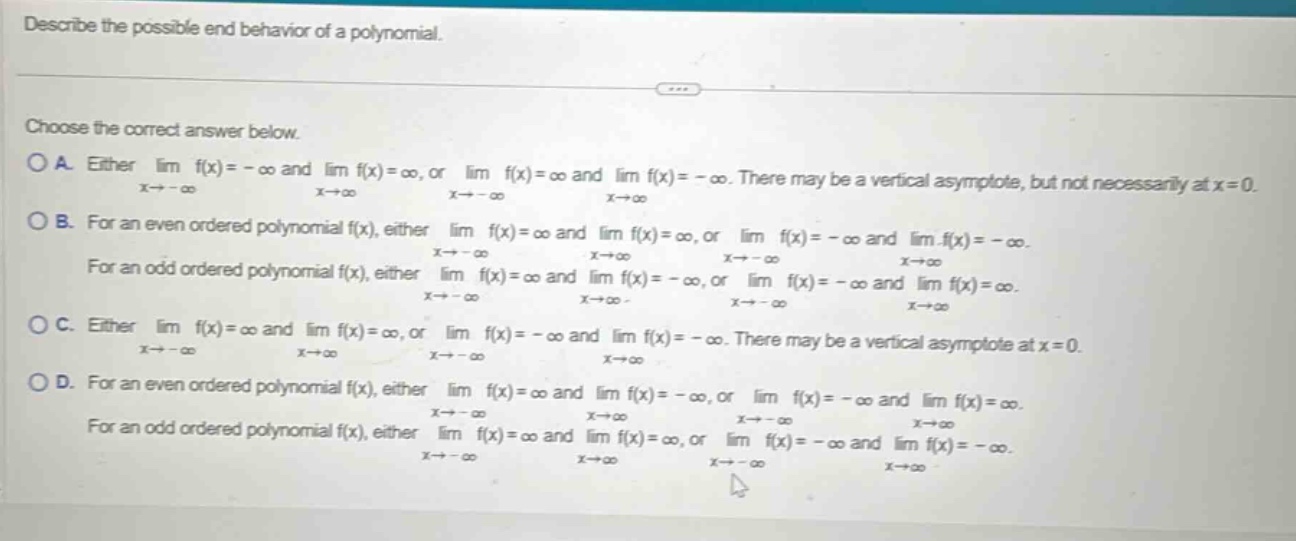
describe the possible end behavior of a polynomial. choose the correct answer below. o a. either lim f(x)= - ∞ and lim f(x)=∞, or lim f(x)=∞ and lim f(x)= - ∞. there may be a vertical asymptote, but not necessarily at x = 0. x→ - ∞ x→∞ x→ - ∞ x→∞ o b. for an even ordered polynomial f(x), either lim f(x)=∞ and lim f(x)=∞, or lim f(x)= - ∞ and lim f(x)= - ∞. x→ - ∞ x→∞ x→ - ∞ x→∞ for an odd ordered polynomial f(x), either lim f(x)=∞ and lim f(x)= - ∞, or lim f(x)= - ∞ and lim f(x)=∞. x→ - ∞ x→∞ x→ - ∞ x→∞ o c. either lim f(x)=∞ and lim f(x)=∞, or lim f(x)= - ∞ and lim f(x)= - ∞. there may be a vertical asymptote at x = 0. x→ - ∞ x→∞ x→ - ∞ x→∞ o d. for an even ordered polynomial f(x), either lim f(x)=∞ and lim f(x)= - ∞, or lim f(x)= - ∞ and lim f(x)=∞. x→ - ∞ x→∞ x→ - ∞ x→∞ for an odd ordered polynomial f(x), either lim f(x)=∞ and lim f(x)=∞, or lim f(x)= - ∞ and lim f(x)= - ∞. x→ - ∞ x→∞ x→ - ∞ x→∞
Answer
Brief Explanations:
The end - behavior of a polynomial depends on its degree (even or odd) and the sign of the leading coefficient. For an even - degree polynomial, the limits as $x\to-\infty$ and $x\to\infty$ have the same sign (both $\infty$ or both $-\infty$). For an odd - degree polynomial, the limits as $x\to-\infty$ and $x\to\infty$ have opposite signs (one is $\infty$ and the other is $-\infty$). Polynomials do not have vertical asymptotes.
Answer:
B. For an even ordered polynomial f(x), either $\lim_{x\to-\infty}f(x)=\infty$ and $\lim_{x\to\infty}f(x)=\infty$, or $\lim_{x\to-\infty}f(x)=-\infty$ and $\lim_{x\to\infty}f(x)=-\infty$. For an odd ordered polynomial f(x), either $\lim_{x\to-\infty}f(x)=\infty$ and $\lim_{x\to\infty}f(x)=-\infty$, or $\lim_{x\to-\infty}f(x)=-\infty$ and $\lim_{x\to\infty}f(x)=\infty$.