describe the possible end - behavior of a polynomial. choose the correct answer below. a. for an even…
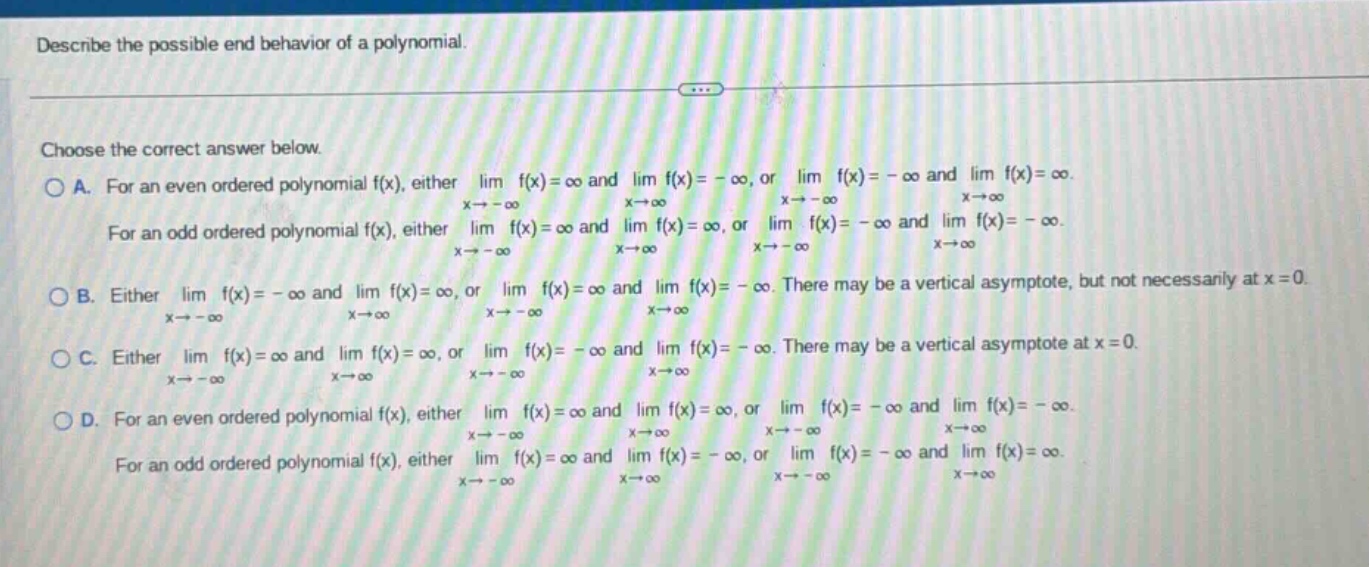
describe the possible end - behavior of a polynomial. choose the correct answer below. a. for an even ordered polynomial f(x), either lim f(x)=∞ and lim f(x)= - ∞, or lim f(x)= - ∞ and lim f(x)=∞. x→ - ∞ x→∞ x→ - ∞ x→∞ for an odd ordered polynomial f(x), either lim f(x)=∞ and lim f(x)=∞, or lim f(x)= - ∞ and lim f(x)= - ∞. x→ - ∞ x→∞ x→ - ∞ x→∞ b. either lim f(x)= - ∞ and lim f(x)=∞, or lim f(x)=∞ and lim f(x)= - ∞. there may be a vertical asymptote, but not necessarily at x = 0. x→ - ∞ x→∞ x→ - ∞ x→∞ c. either lim f(x)=∞ and lim f(x)=∞, or lim f(x)= - ∞ and lim f(x)= - ∞. there may be a vertical asymptote at x = 0. x→ - ∞ x→∞ x→ - ∞ x→∞ d. for an even ordered polynomial f(x), either lim f(x)=∞ and lim f(x)=∞, or lim f(x)= - ∞ and lim f(x)= - ∞. x→ - ∞ x→∞ x→ - ∞ x→∞ for an odd ordered polynomial f(x), either lim f(x)=∞ and lim f(x)= - ∞, or lim f(x)= - ∞ and lim f(x)=∞. x→ - ∞ x→∞ x→ - ∞ x→∞
Answer
Explanation:
Step1: Recall polynomial end - behavior rules
The end - behavior of a polynomial (y = f(x)=a_nx^n+\cdots + a_0) is determined by the leading term (a_nx^n), where (n) is the degree of the polynomial and (a_n\neq0).
Step2: Analyze even - degree polynomials
For an even - degree polynomial ((n = 2k,k\in\mathbb{Z})), if (a_n>0), then (\lim_{x\rightarrow-\infty}f(x)=\infty) and (\lim_{x\rightarrow\infty}f(x)=\infty). If (a_n < 0), then (\lim_{x\rightarrow-\infty}f(x)=-\infty) and (\lim_{x\rightarrow\infty}f(x)=-\infty).
Step3: Analyze odd - degree polynomials
For an odd - degree polynomial ((n = 2k + 1,k\in\mathbb{Z})), if (a_n>0), then (\lim_{x\rightarrow-\infty}f(x)=-\infty) and (\lim_{x\rightarrow\infty}f(x)=\infty). If (a_n<0), then (\lim_{x\rightarrow-\infty}f(x)=\infty) and (\lim_{x\rightarrow\infty}f(x)=-\infty).
Step4: Evaluate options
Option A has incorrect end - behavior for odd - degree polynomials. Option B and C do not consider the correct cases for even and odd polynomials and also introduce the concept of vertical asymptotes which are not present in polynomials. Option D correctly describes the end - behavior of even and odd - degree polynomials.
Answer:
D. For an even ordered polynomial (f(x)), either (\lim_{x\rightarrow-\infty}f(x)=\infty) and (\lim_{x\rightarrow\infty}f(x)=\infty), or (\lim_{x\rightarrow-\infty}f(x)=-\infty) and (\lim_{x\rightarrow\infty}f(x)=-\infty). For an odd ordered polynomial (f(x)), either (\lim_{x\rightarrow-\infty}f(x)=\infty) and (\lim_{x\rightarrow\infty}f(x)=-\infty), or (\lim_{x\rightarrow-\infty}f(x)=-\infty) and (\lim_{x\rightarrow\infty}f(x)=\infty).