determine $c_1$ and $c_2$ so that $y(x)=c_1e^{2x}+c_2e^{x}+2sin x$ will satisfy the conditions $y(0) = 0$…
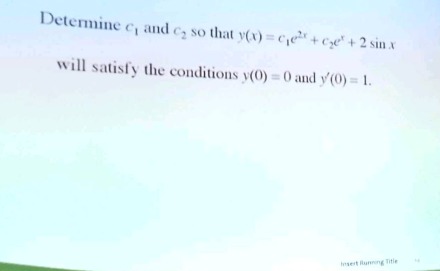
determine $c_1$ and $c_2$ so that $y(x)=c_1e^{2x}+c_2e^{x}+2sin x$ will satisfy the conditions $y(0) = 0$ and $y(0)=1$.
Answer
Explanation:
Step1: Find (y(0))
Substitute (x = 0) into (y(x)=c_1e^{2x}+c_2e^{x}+2\sin x). [y(0)=c_1e^{2\times0}+c_2e^{0}+2\sin(0)=c_1 + c_2+0] Since (y(0) = 0), we have (c_1 + c_2=0), so (c_2=-c_1).
Step2: Find (y^{\prime}(x))
Differentiate (y(x)=c_1e^{2x}+c_2e^{x}+2\sin x) with respect to (x). [y^{\prime}(x)=2c_1e^{2x}+c_2e^{x}+2\cos x]
Step3: Find (y^{\prime}(0))
Substitute (x = 0) into (y^{\prime}(x)). [y^{\prime}(0)=2c_1e^{2\times0}+c_2e^{0}+2\cos(0)=2c_1 + c_2+2] Since (y^{\prime}(0) = 1), we have (2c_1 + c_2+2 = 1), or (2c_1 + c_2=-1).[Client Connection Error]