determine the amplitude and period of the function. graph the function. y = - 3 cos 4/3 x
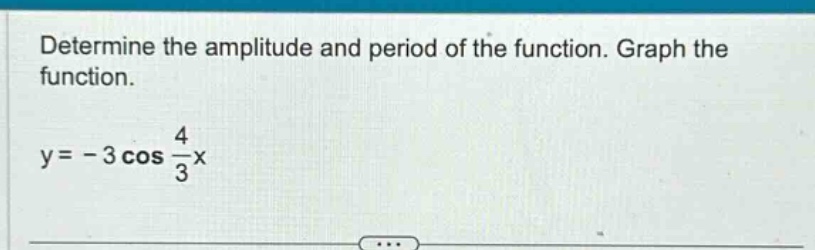
determine the amplitude and period of the function. graph the function. y = - 3 cos 4/3 x
Answer
Explanation:
Step1: Recall amplitude formula
For a cosine function of the form $y = A\cos(Bx)$, the amplitude is given by $|A|$. In the function $y=- 3\cos(\frac{4}{3}x)$, $A = - 3$.
Step2: Calculate amplitude
$|A|=|-3| = 3$.
Step3: Recall period formula
The period of a cosine function $y = A\cos(Bx)$ is $T=\frac{2\pi}{|B|}$. Here, $B=\frac{4}{3}$.
Step4: Calculate period
$T=\frac{2\pi}{\left|\frac{4}{3}\right|}=\frac{2\pi}{\frac{4}{3}}=\frac{3\pi}{2}$.
Answer:
Amplitude: $3$; Period: $\frac{3\pi}{2}$