determine the amplitude, period, and phase shift (if any) of the given function. graph the function. y = sin…
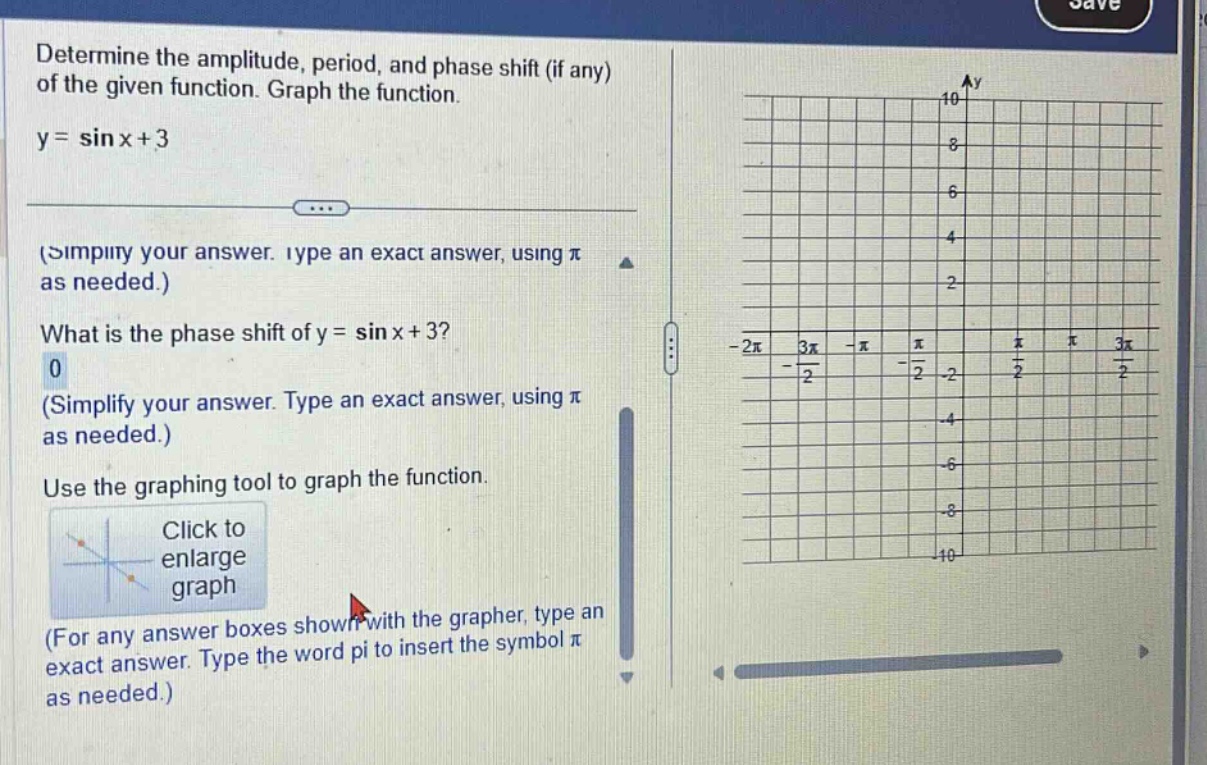
determine the amplitude, period, and phase shift (if any) of the given function. graph the function. y = sin x+3 (simplify your answer. type an exact answer, using π as needed.) what is the phase shift of y = sin x+3? 0 (simplify your answer. type an exact answer, using π as needed.) use the graphing tool to graph the function. click to enlarge graph (for any answer boxes shown with the grapher, type an exact answer. type the word pi to insert the symbol π as needed.)
Answer
Explanation:
Step1: Recall amplitude formula
For $y = A\sin(Bx - C)+D$, amplitude is $|A|$. In $y=\sin x + 3$, $A = 1$, so amplitude $|1|=1$.
Step2: Recall period formula
The period of $y = A\sin(Bx - C)+D$ is $T=\frac{2\pi}{|B|}$. Here $B = 1$, so $T=\frac{2\pi}{|1|}=2\pi$.
Step3: Recall phase - shift formula
The phase - shift of $y = A\sin(Bx - C)+D$ is $\frac{C}{B}$. In $y=\sin x + 3$, $C = 0$ and $B = 1$, so phase - shift is $\frac{0}{1}=0$.
Answer:
Amplitude: $1$ Period: $2\pi$ Phase - shift: $0$