determine the amplitude, the period, and the phase shift of the function. y = 8 sin (1/4 x - π/2) write the…
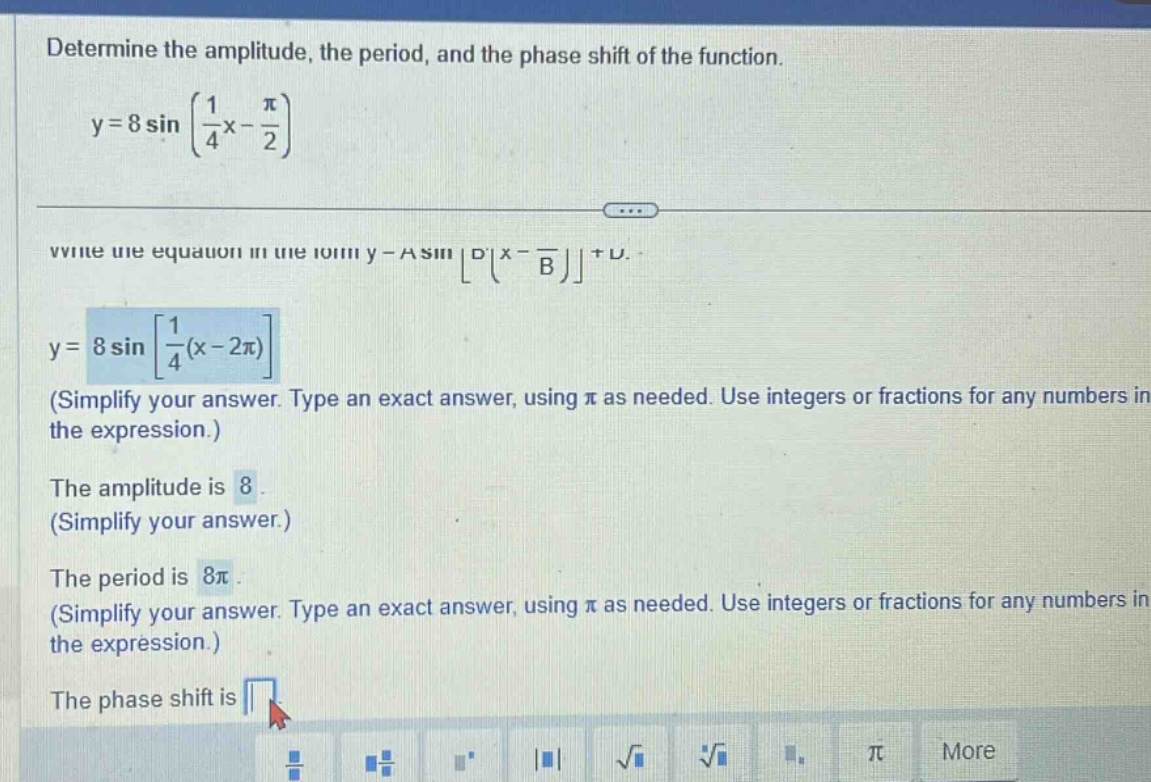
determine the amplitude, the period, and the phase shift of the function. y = 8 sin (1/4 x - π/2) write the equation in the form y = a sin d (x - b) + c. y = 8 sin 1/4 (x - 2π) (simplify your answer. type an exact answer, using π as needed. use integers or fractions for any numbers in the expression.) the amplitude is 8. (simplify your answer.) the period is 8π. (simplify your answer. type an exact answer, using π as needed. use integers or fractions for any numbers in the expression.) the phase shift is
Answer
Explanation:
Step1: Recall the general form of sine - function
The general form of a sine function is $y = A\sin\left[B(x - C)\right]+D$, where $A$ is the amplitude, the period $T=\frac{2\pi}{|B|}$, and the phase - shift is $C$.
Step2: Identify the values of $A$, $B$, and $C$ for the function $y = 8\sin\left[\frac{1}{4}(x - 2\pi)\right]$
Here, $A = 8$, $B=\frac{1}{4}$, and $C = 2\pi$.
Step3: Calculate the phase - shift
The phase - shift of the function $y = A\sin\left[B(x - C)\right]+D$ is given by $C$. Since $C = 2\pi$ for the function $y = 8\sin\left[\frac{1}{4}(x - 2\pi)\right]$, the phase - shift is $2\pi$.
Answer:
$2\pi$