determine the amplitude or period as requested.\namplitude of ( y = -\frac{1}{5}sin x )\na. ( -\frac{1}{5}…
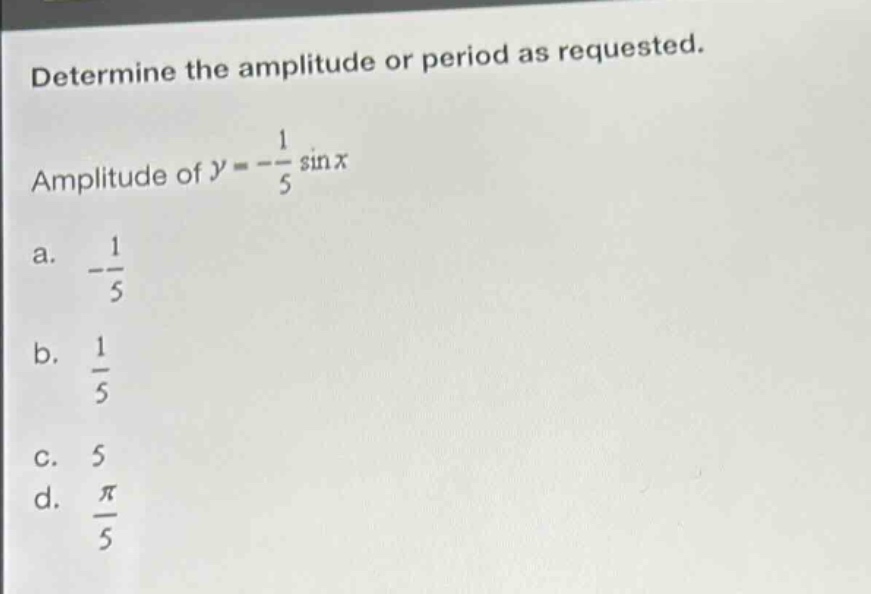
determine the amplitude or period as requested.\namplitude of ( y = -\frac{1}{5}sin x )\na. ( -\frac{1}{5} )\nb. ( \frac{1}{5} )\nc. 5\nd. ( \frac{pi}{5} )
Answer
Explanation:
Step1: Recall the formula for the amplitude
For the function (y = A\sin x), the amplitude is given by (|A|).
Step2: Identify (A) in the given function
In the function (y =-\frac{1}{5}\sin x), (A =-\frac{1}{5}).
Step3: Calculate the amplitude
Using the formula (|A|), we substitute (A =-\frac{1}{5}). So, (|-\frac{1}{5}|=\frac{1}{5}).
Answer:
B. (\frac{1}{5})