determine the amplitude, range, period, and phase - shift and then sketch the graph of the function using…
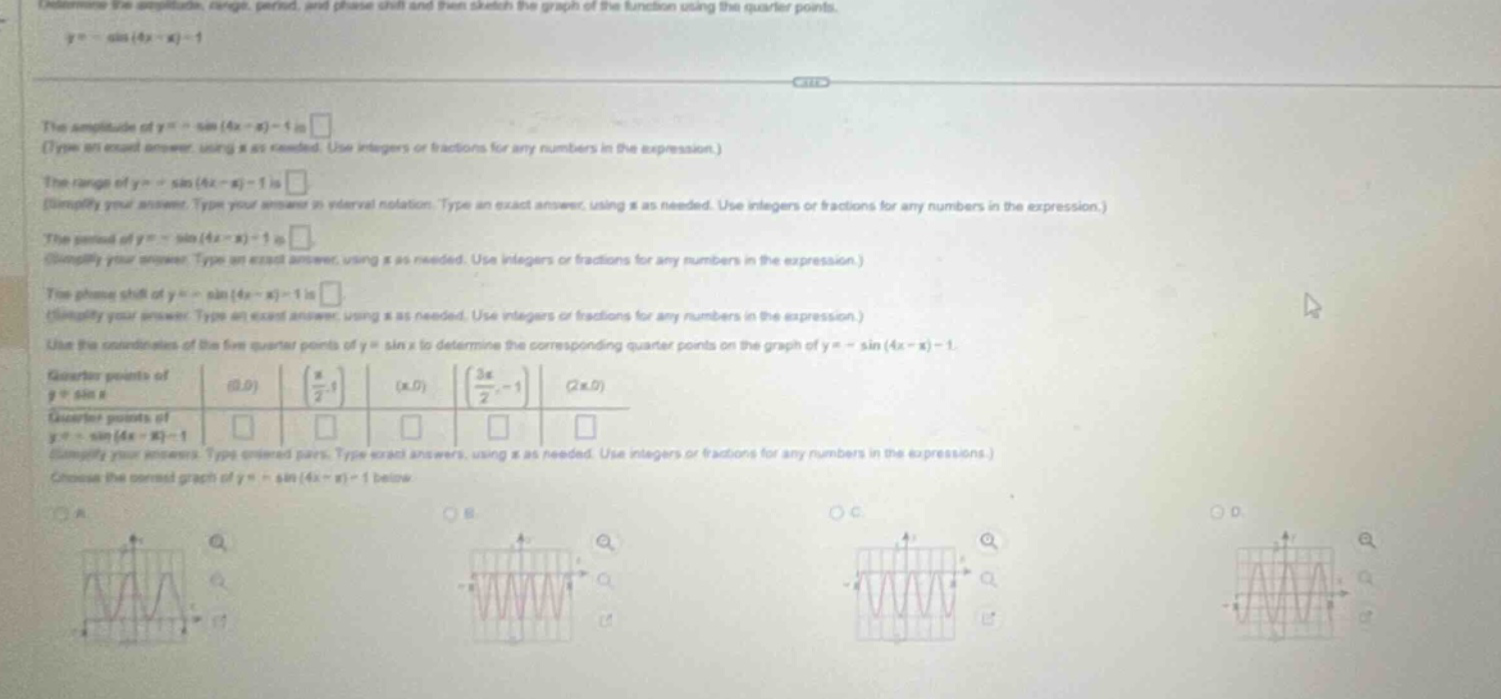
determine the amplitude, range, period, and phase - shift and then sketch the graph of the function using the quarter - points. y=-sin(4x - π)-1\nthe amplitude of y=-sin(4x - π)-1 is \n(type an exact answer, using π as needed. use integers or fractions for any numbers in the expression.)\nthe range of y=-sin(4x - π)-1 is \n(simplify your answer. type your answer in interval notation. type an exact answer, using π as needed. use integers or fractions for any numbers in the expression.)\nthe period of y=-sin(4x - π)-1 is \n(simplify your answer. type an exact answer, using π as needed. use integers or fractions for any numbers in the expression.)\nthe phase shift of y=-sin(4x - π)-1 is \n(simplify your answer. type an exact answer, using π as needed. use integers or fractions for any numbers in the expression.)\nuse the coordinates of the five quarter - points of y = sin x to determine the corresponding quarter - points on the graph of y=-sin(4x - π)-1.\nquarter - points of y = sin x: (0,0) (π/2,1) (π,0) (3π/2,-1) (2π,0)\nquarter - points of y=-sin(4x - π)-1: \n(simplify your answers. type ordered pairs. type exact answers, using π as needed. use integers or fractions for any numbers in the expressions.)\nchoose the correct graph of y=-sin(4x - π)-1 below.
Answer
Explanation:
Step1: Recall amplitude formula
For $y = A\sin(Bx - C)+D$, the amplitude is $|A|$. In $y=-\sin(4x - \pi)-1$, $A=- 1$, so the amplitude is $| - 1|=1$.
Step2: Find the range
The range of $y = \sin t$ is $[-1,1]$. For $y=-\sin(4x - \pi)-1$, when $\sin(4x - \pi)=-1$, $y=-(-1)-1 = 0$; when $\sin(4x - \pi)=1$, $y=-1 - 1=-2$. So the range is $[-2,0]$.
Step3: Calculate the period
The period formula for $y = \sin(Bx - C)+D$ is $T=\frac{2\pi}{|B|}$. Here $B = 4$, so $T=\frac{2\pi}{4}=\frac{\pi}{2}$.
Step4: Determine the phase - shift
The phase - shift formula for $y=\sin(Bx - C)+D$ is $\frac{C}{B}$. Here $C=\pi$ and $B = 4$, so the phase - shift is $\frac{\pi}{4}$.
Step5: Find the quarter - points
For $y = \sin x$, the quarter - points are $(0,0),(\frac{\pi}{2},1),(\pi,0),(\frac{3\pi}{2},-1),(2\pi,0)$. For $y=-\sin(4x - \pi)-1$, let $t = 4x-\pi$. When $t = 0$ (corresponding to the first quarter - point of $\sin t$), $4x-\pi=0\Rightarrow x=\frac{\pi}{4}$, and $y=-0 - 1=-1$. When $t=\frac{\pi}{2}$, $4x-\pi=\frac{\pi}{2}\Rightarrow x=\frac{3\pi}{8}$, and $y=-1 - 1=-2$. When $t=\pi$, $4x-\pi=\pi\Rightarrow x=\frac{\pi}{2}$, and $y=-0 - 1=-1$. When $t=\frac{3\pi}{2}$, $4x-\pi=\frac{3\pi}{2}\Rightarrow x=\frac{5\pi}{8}$, and $y=-(-1)-1 = 0$. When $t = 2\pi$, $4x-\pi=2\pi\Rightarrow x=\frac{3\pi}{4}$, and $y=-0 - 1=-1$. The quarter - points are $(\frac{\pi}{4},-1),(\frac{3\pi}{8},-2),(\frac{\pi}{2},-1),(\frac{5\pi}{8},0),(\frac{3\pi}{4},-1)$.
Answer:
Amplitude: $1$ Range: $[-2,0]$ Period: $\frac{\pi}{2}$ Phase - shift: $\frac{\pi}{4}$ Quarter - points: $(\frac{\pi}{4},-1),(\frac{3\pi}{8},-2),(\frac{\pi}{2},-1),(\frac{5\pi}{8},0),(\frac{3\pi}{4},-1)$