determine the average rate of change of the function on the given interval. express your answer in exact…
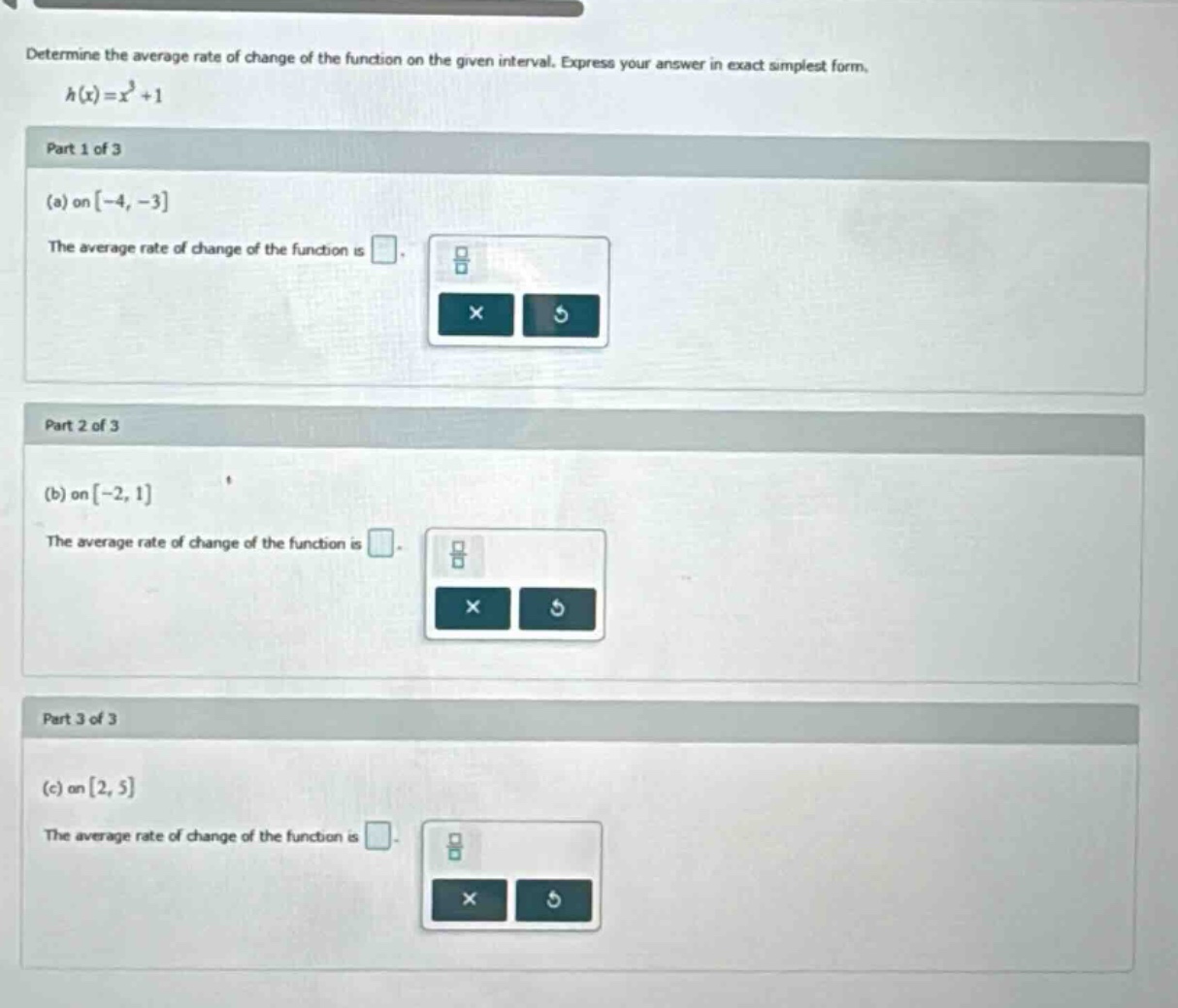
determine the average rate of change of the function on the given interval. express your answer in exact simplest form. h(x)=x³ + 1 part 1 of 3 (a) on -4, -3 the average rate of change of the function is. part 2 of 3 (b) on -2, 1 the average rate of change of the function is. part 3 of 3 (c) on 2, 5 the average rate of change of the function is.
Answer
Explanation:
Step1: Recall average - rate - of - change formula
The average rate of change of a function $y = h(x)$ on the interval $[a,b]$ is $\frac{h(b)-h(a)}{b - a}$.
Step2: Calculate for part (a)
For $h(x)=x^{3}+1$ on $[-4,-3]$, $a=-4$, $b = - 3$. First, find $h(-3)$ and $h(-4)$: $h(-3)=(-3)^{3}+1=-27 + 1=-26$. $h(-4)=(-4)^{3}+1=-64 + 1=-63$. Then, $\frac{h(-3)-h(-4)}{-3-(-4)}=\frac{-26-(-63)}{-3 + 4}=\frac{-26 + 63}{1}=37$.
Step3: Calculate for part (b)
For $h(x)=x^{3}+1$ on $[-2,1]$, $a=-2$, $b = 1$. $h(1)=1^{3}+1=2$. $h(-2)=(-2)^{3}+1=-8 + 1=-7$. Then, $\frac{h(1)-h(-2)}{1-(-2)}=\frac{2-(-7)}{1 + 2}=\frac{2 + 7}{3}=3$.
Step4: Calculate for part (c)
For $h(x)=x^{3}+1$ on $[2,5]$, $a = 2$, $b = 5$. $h(5)=5^{3}+1=125+1=126$. $h(2)=2^{3}+1=8 + 1=9$. Then, $\frac{h(5)-h(2)}{5-2}=\frac{126 - 9}{3}=\frac{117}{3}=39$.
Answer:
(a) 37 (b) 3 (c) 39