5.) determine an equation for this graph: 1 y = 3sin(3x) 2 y = sin(3x) 3 y = 3sin(x) 4 y = sin(1/3x) 6.)…
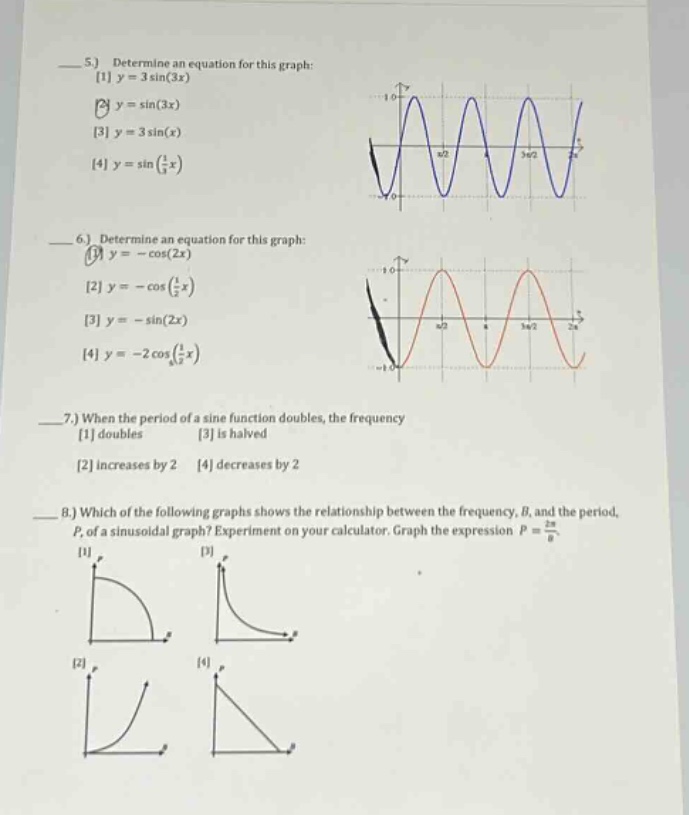
5.) determine an equation for this graph: 1 y = 3sin(3x) 2 y = sin(3x) 3 y = 3sin(x) 4 y = sin(1/3x) 6.) determine an equation for this graph: 1 y = -cos(2x) 2 y = -cos(1/2x) 3 y = -sin(2x) 4 y = -2cos(1/2x) 7.) when the period of a sine function doubles, the frequency 1 doubles 3 is halved 2 increases by 2 4 decreases by 2 8.) which of the following graphs shows the relationship between the frequency, b, and the period, p, of a sinusoidal graph? experiment on your calculator. graph the expression p = 2π/b 1 2 3 4
Answer
Explanation:
Step1: Recall general form of sine - function
The general form of a sine - function is $y = A\sin(Bx)$ where $A$ is the amplitude and the period $T=\frac{2\pi}{B}$.
Step2: Analyze problem 5
For the graph in problem 5, the amplitude $A = 1$ (the distance from the mid - line to the maximum or minimum value) and the period $T=\frac{2\pi}{3}$. Since $T=\frac{2\pi}{B}$, then $\frac{2\pi}{B}=\frac{2\pi}{3}$, so $B = 3$. The equation is $y=\sin(3x)$.
Step3: Analyze problem 6
For the graph in problem 6, it is a cosine - function reflected about the $x$ - axis with amplitude $A = 1$ and period $T=\pi$. For the general form $y=-A\cos(Bx)$, since $T=\frac{2\pi}{B}=\pi$, then $B = 2$. The equation is $y =-\cos(2x)$.
Step4: Recall relationship between period and frequency
The frequency $f$ and period $T$ of a periodic function are related by $f=\frac{1}{T}$. If $T$ doubles (new $T' = 2T$), then new $f'=\frac{1}{T'}=\frac{1}{2T}=\frac{1}{2}f$. So when the period of a sine function doubles, the frequency is halved.
Step5: Analyze relationship between period and frequency graphically
Given $P=\frac{2\pi}{B}$, we can rewrite it as $B=\frac{2\pi}{P}$. This is an inverse - relationship. The graph of an inverse relationship $y=\frac{k}{x}$ ($k = 2\pi$ in our case) is a hyperbola. Among the given graphs, the one that represents an inverse relationship is a curve that decreases as $x$ (in our case $P$) increases.
Answer:
- [2] $y=\sin(3x)$
- [1] $y =-\cos(2x)$
- [3] Is halved
- [3] (the graph representing an inverse - relationship)