2. determine the features of the following function, then graph at least one period of the function…
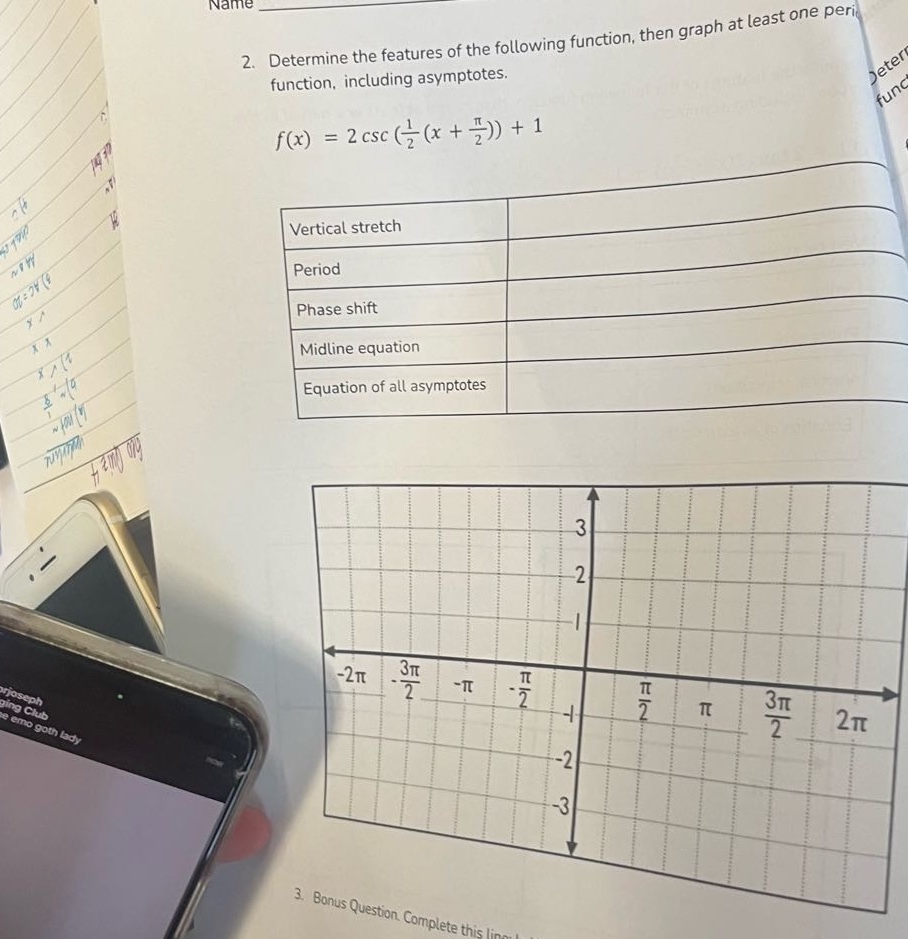
2. determine the features of the following function, then graph at least one period of the function, including asymptotes. f(x)=2 csc(1/2(x + π/2))+1 vertical stretch period phase shift midline equation equation of all asymptotes 3. bonus question. complete this line
Answer
Explanation:
Step1: Identify vertical - stretch factor
For the function $y = A\csc(B(x - C))+D$, the vertical - stretch factor is given by $|A|$. Here, $A = 2$, so the vertical stretch is $2$.
Step2: Calculate the period
The period of the cosecant function $y=\csc(B(x - C))+D$ is $T=\frac{2\pi}{|B|}$. Given $B=\frac{1}{2}$, then $T=\frac{2\pi}{\frac{1}{2}} = 4\pi$.
Step3: Determine the phase - shift
The phase - shift of the function $y = A\csc(B(x - C))+D$ is $C$. Here, $C=-\frac{\pi}{2}$, so the phase shift is $-\frac{\pi}{2}$ (or $\frac{\pi}{2}$ to the left).
Step4: Find the mid - line equation
The mid - line of the function $y = A\csc(B(x - C))+D$ is $y = D$. Since $D = 1$, the midline equation is $y = 1$.
Step5: Find the equation of all asymptotes
The asymptotes of the basic cosecant function $y=\csc(x)$ occur at $x = n\pi$, where $n\in\mathbb{Z}$. For the function $y = 2\csc(\frac{1}{2}(x+\frac{\pi}{2})) + 1$, we set $\frac{1}{2}(x+\frac{\pi}{2})=n\pi$. Solving for $x$ gives $x = 2n\pi-\frac{\pi}{2}$, where $n\in\mathbb{Z}$.
Answer:
| Feature | Value |
|---|---|
| Vertical stretch | $2$ |
| Period | $4\pi$ |
| Phase shift | $-\frac{\pi}{2}$ |
| Midline equation | $y = 1$ |
| Equation of all asymptotes | $x = 2n\pi-\frac{\pi}{2},n\in\mathbb{Z}$ |