determine the first derivative of the given functions.\n1. $y = 3^{\tan x}5^{cos x}$\n2. $y =…
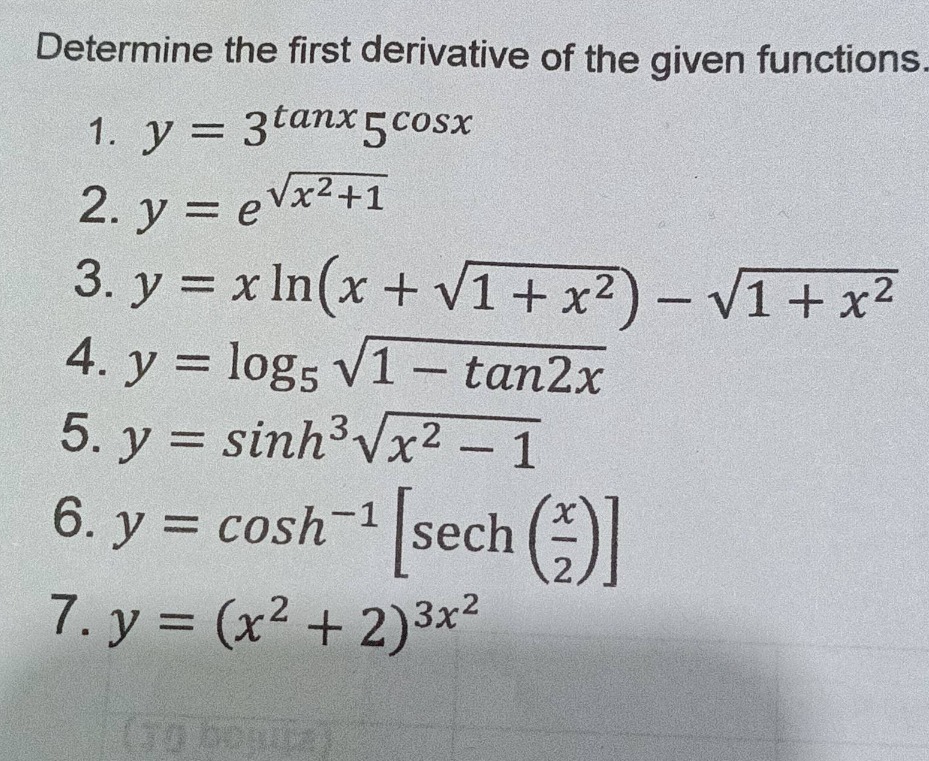
determine the first derivative of the given functions.\n1. $y = 3^{\tan x}5^{cos x}$\n2. $y = e^{sqrt{x^{2}+1}}$\n3. $y = xln(x + sqrt{1 + x^{2}})-sqrt{1 + x^{2}}$\n4. $y = log_{5}sqrt{1 - \tan2x}$\n5. $y = sinh^{3}sqrt{x^{2}-1}$\n6. $y = cosh^{-1}\text{sech}(\frac{x}{2})$\n7. $y = (x^{2}+2)^{3x^{2}}$
Answer
1. For (y = 3^{\tan x}5^{\cos x})
Explanation:
Step1: Use the product - rule ((uv)^\prime=u^\prime v + uv^\prime)
Let (u = 3^{\tan x}) and (v = 5^{\cos x}). First, find (u^\prime) and (v^\prime) using the formula ((a^{f(x)})^\prime=a^{f(x)}\ln a\cdot f^\prime(x)). For (u = 3^{\tan x}), (u^\prime=3^{\tan x}\ln 3\cdot\sec^{2}x). For (v = 5^{\cos x}), (v^\prime=5^{\cos x}\ln 5\cdot(-\sin x)). Then (y^\prime=3^{\tan x}\ln 3\cdot\sec^{2}x\cdot5^{\cos x}+3^{\tan x}\cdot5^{\cos x}\ln 5\cdot(-\sin x)=3^{\tan x}5^{\cos x}(\ln 3\cdot\sec^{2}x-\ln 5\cdot\sin x))
2. For (y = e^{\sqrt{x^{2}+1}})
Step1: Use the chain - rule ((f(g(x)))^\prime=f^\prime(g(x))\cdot g^\prime(x))
Let (u=\sqrt{x^{2}+1}=(x^{2}+1)^{\frac{1}{2}}). Then (y = e^{u}). First, find (u^\prime): (u^\prime=\frac{1}{2}(x^{2}+1)^{-\frac{1}{2}}\cdot2x=\frac{x}{\sqrt{x^{2}+1}}). Since (y^\prime = e^{u}\cdot u^\prime), substituting (u) and (u^\prime) gives (y^\prime=e^{\sqrt{x^{2}+1}}\cdot\frac{x}{\sqrt{x^{2}+1}}=\frac{x e^{\sqrt{x^{2}+1}}}{\sqrt{x^{2}+1}})
3. For (y = x\ln(x + \sqrt{1 + x^{2}})-\sqrt{1 + x^{2}})
Step1: Use the product - rule for the first term ((uv)^\prime=u^\prime v+uv^\prime)
Let (u = x) and (v=\ln(x+\sqrt{1 + x^{2}})). (u^\prime = 1), and (v^\prime=\frac{1+\frac{x}{\sqrt{1 + x^{2}}}}{x+\sqrt{1 + x^{2}}}=\frac{1}{\sqrt{1 + x^{2}}}) (by rationalizing the numerator). The derivative of the first term ((x\ln(x + \sqrt{1 + x^{2}}))^\prime=\ln(x+\sqrt{1 + x^{2}})+\frac{x}{\sqrt{1 + x^{2}}}). The derivative of (-\sqrt{1 + x^{2}}=-\frac{x}{\sqrt{1 + x^{2}}}). So (y^\prime=\ln(x+\sqrt{1 + x^{2}}))
4. For (y=\log_{5}\sqrt{1 - \tan2x}=\frac{1}{2}\log_{5}(1 - \tan2x))
Step1: Use the chain - rule and the formula ((\log_{a}u)^\prime=\frac{u^\prime}{u\ln a})
Let (u = 1-\tan2x), then (u^\prime=-2\sec^{2}2x). (y^\prime=\frac{1}{2}\cdot\frac{-2\sec^{2}2x}{(1 - \tan2x)\ln 5}=\frac{-\sec^{2}2x}{(1 - \tan2x)\ln 5})
5. For (y = \sinh^{3}\sqrt{x^{2}-1})
Step1: Use the chain - rule multiple times
Let (u=\sqrt{x^{2}-1}=(x^{2}-1)^{\frac{1}{2}}), (v = \sinh u), and (y = v^{3}). (u^\prime=\frac{x}{\sqrt{x^{2}-1}}), (v^\prime=\cosh u), (y^\prime = 3v^{2}\cdot v^\prime). Substituting (u) and (v) back in, we get (y^\prime=3\sinh^{2}\sqrt{x^{2}-1}\cdot\cosh\sqrt{x^{2}-1}\cdot\frac{x}{\sqrt{x^{2}-1}}=\frac{3x\sinh^{2}\sqrt{x^{2}-1}\cosh\sqrt{x^{2}-1}}{\sqrt{x^{2}-1}})
6. For (y=\cosh^{-1}[\text{sech}(\frac{x}{2})])
Step1: Use the chain - rule and the formula ((\cosh^{-1}u)^\prime=\frac{u^\prime}{\sqrt{u^{2}-1}})
Let (u = \text{sech}(\frac{x}{2})), then (u^\prime=-\text{sech}(\frac{x}{2})\tanh(\frac{x}{2})\cdot\frac{1}{2}). (y^\prime=\frac{-\frac{1}{2}\text{sech}(\frac{x}{2})\tanh(\frac{x}{2})}{\sqrt{\text{sech}^{2}(\frac{x}{2})-1}})
7. For (y=(x^{2}+2)^{3x^{2}})
Step1: Take the natural logarithm of both sides
(\ln y = 3x^{2}\ln(x^{2}+2))
Step2: Differentiate both sides with respect to (x)
Using the product - rule on the right - hand side: (\frac{y^\prime}{y}=6x\ln(x^{2}+2)+3x^{2}\cdot\frac{2x}{x^{2}+2})
Step3: Solve for (y^\prime)
(y^\prime=(x^{2}+2)^{3x^{2}}\left(6x\ln(x^{2}+2)+\frac{6x^{3}}{x^{2}+2}\right))