determine the following characteristics of the graph.\n$y = \\frac{4x}{5x^{2}-180}$\ntype dne if the answer…
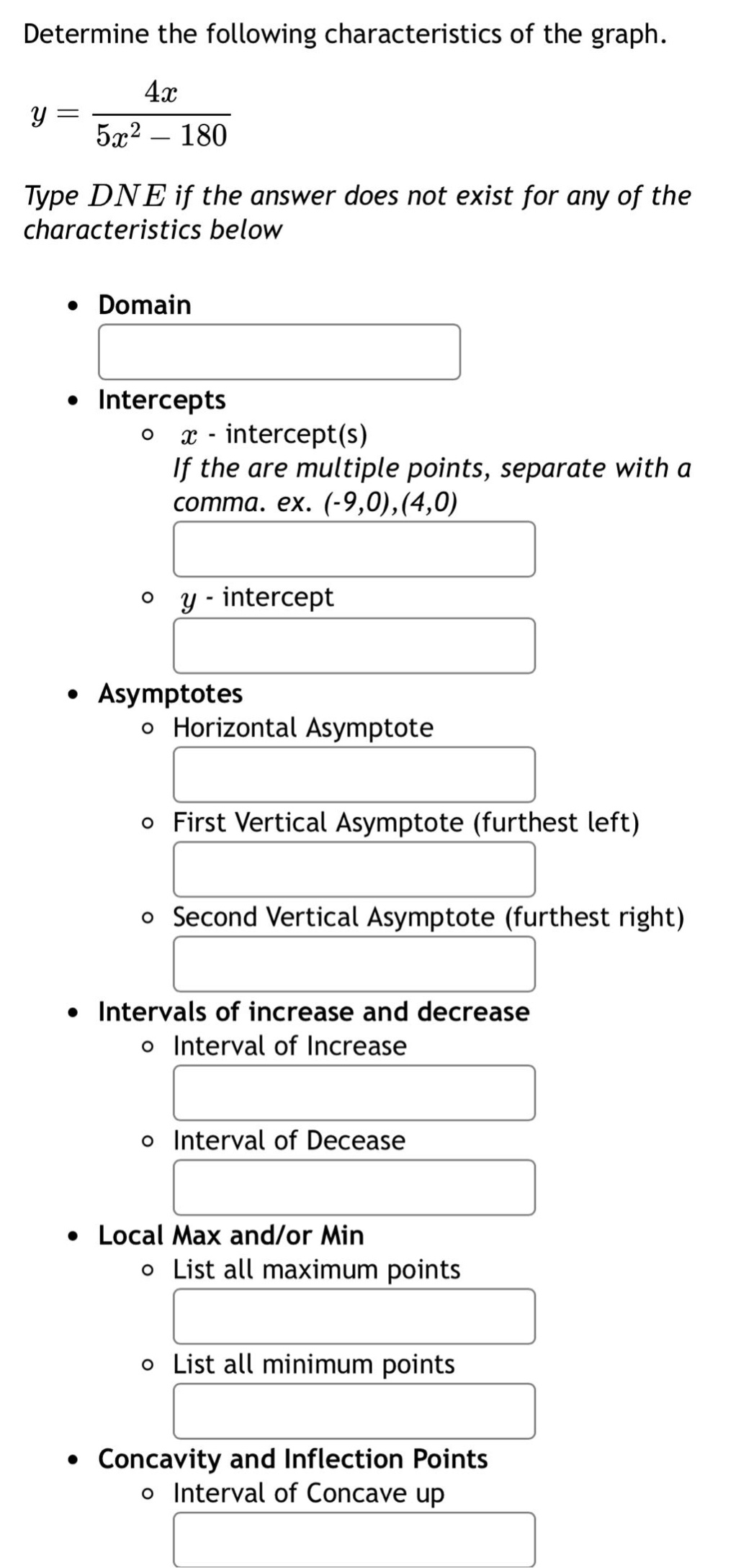
determine the following characteristics of the graph.\n$y = \\frac{4x}{5x^{2}-180}$\ntype dne if the answer does not exist for any of the characteristics below\n- domain\n- intercepts\n - $x$-intercept(s)\n if the are multiple points, separate with a comma. ex. (-9,0),(4,0)\n - $y$-intercept\n- asymptotes\n - horizontal asymptote\n - first vertical asymptote (furthest left)\n - second vertical asymptote (furthest right)\n- intervals of increase and decrease\n - interval of increase\n - interval of decease\n- local max and/or min\n - list all maximum points\n - list all minimum points\n- concavity and inflection points\n - interval of concave up
Answer
Explanation:
Step1: Find the domain
Set the denominator not equal to 0. So, $5x^{2}-180\neq0$. Solve $5x^{2}-180 = 0$, we have $x^{2}=36$, then $x=\pm6$. The domain is $(-\infty,- 6)\cup(-6,6)\cup(6,\infty)$.
Step2: Find the x - intercept
Set $y = 0$, then $\frac{4x}{5x^{2}-180}=0$. Since the fraction is 0 when the numerator is 0 and the denominator is not 0, $4x = 0$ gives $x = 0$. So the x - intercept is $(0,0)$.
Step3: Find the y - intercept
Set $x = 0$, then $y=\frac{4\times0}{5\times0^{2}-180}=0$. So the y - intercept is 0.
Step4: Find the horizontal asymptote
Degree of numerator $n = 1$, degree of denominator $m=2$. Since $n<m$, the horizontal asymptote is $y = 0$.
Step5: Find the vertical asymptotes
From $5x^{2}-180=0$, we get $x=-6$ and $x = 6$. The first vertical asymptote (furthest left) is $x=-6$ and the second vertical asymptote (furthest right) is $x = 6$.
Step6: Find intervals of increase and decrease
First, find the derivative using the quotient rule. If $y=\frac{u}{v}$ where $u = 4x$ and $v=5x^{2}-180$, then $y'=\frac{u'v - uv'}{v^{2}}=\frac{4(5x^{2}-180)-4x(10x)}{(5x^{2}-180)^{2}}=\frac{20x^{2}-720 - 40x^{2}}{(5x^{2}-180)^{2}}=\frac{- 20x^{2}-720}{(5x^{2}-180)^{2}}<0$ for all $x$ in the domain. So the interval of decrease is $(-\infty,-6)\cup(-6,6)\cup(6,\infty)$ and the interval of increase is DNE.
Step7: Find local max and min
Since the function is always decreasing, there are no local maximum or minimum points. So, maximum points: DNE, minimum points: DNE.
Step8: Find concavity and inflection points
Find the second - derivative. $y'=\frac{-20x^{2}-720}{(5x^{2}-180)^{2}}$. Using the quotient rule again, after simplification, we find the sign of $y''$. The second - derivative $y''$ changes sign at $x = 0$. The interval of concave up is $(-\infty,-6)\cup(-6,0)$.
Answer:
Domain: $(-\infty,-6)\cup(-6,6)\cup(6,\infty)$ x - intercept(s): $(0,0)$ y - intercept: 0 Horizontal Asymptote: $y = 0$ First Vertical Asymptote (furthest left): $x=-6$ Second Vertical Asymptote (furthest right): $x = 6$ Interval of Increase: DNE Interval of Decrease: $(-\infty,-6)\cup(-6,6)\cup(6,\infty)$ List all maximum points: DNE List all minimum points: DNE Interval of Concave up: $(-\infty,-6)\cup(-6,0)$