4. determine if the following improper integrals are convergent or divergent. justify your answers.\n(a) (10…
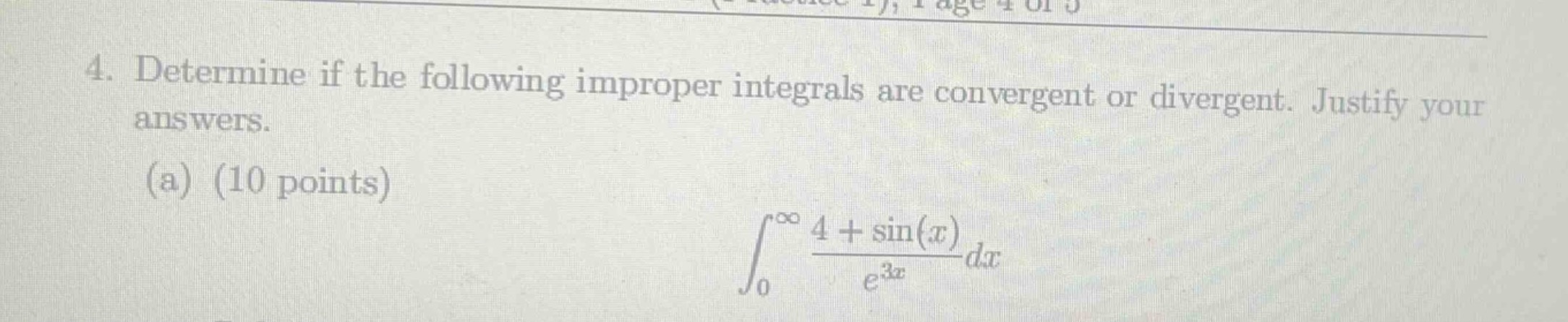
4. determine if the following improper integrals are convergent or divergent. justify your answers.\n(a) (10 points)\n\\(\\int_{0}^{\\infty}\\frac{4 + \\sin(x)}{e^{3x}}dx\\)
Answer
Explanation:
Step1: Use comparison test
We know that $- 1\leqslant\sin(x)\leqslant1$. So, $3\leqslant4 + \sin(x)\leqslant5$. Then $\frac{4+\sin(x)}{e^{3x}}\leqslant\frac{5}{e^{3x}}$.
Step2: Evaluate $\int_{0}^{\infty}\frac{5}{e^{3x}}dx$
We calculate $\int_{0}^{\infty}\frac{5}{e^{3x}}dx = 5\int_{0}^{\infty}e^{-3x}dx$. Let $u=-3x$, $du=-3dx$. When $x = 0$, $u = 0$; when $x\rightarrow\infty$, $u\rightarrow-\infty$. Then $5\int_{0}^{\infty}e^{-3x}dx=5\lim_{b\rightarrow\infty}\int_{0}^{b}e^{-3x}dx=5\lim_{b\rightarrow\infty}\left[-\frac{1}{3}e^{-3x}\right]{0}^{b}=5\lim{b\rightarrow\infty}\left(-\frac{1}{3}e^{-3b}+\frac{1}{3}\right)=\frac{5}{3}$.
Step3: Apply comparison - convergence theorem
Since $\int_{0}^{\infty}\frac{4+\sin(x)}{e^{3x}}dx\leqslant\int_{0}^{\infty}\frac{5}{e^{3x}}dx$ and $\int_{0}^{\infty}\frac{5}{e^{3x}}dx$ converges, by the comparison - convergence theorem for improper integrals, $\int_{0}^{\infty}\frac{4+\sin(x)}{e^{3x}}dx$ converges.
Answer:
The improper integral $\int_{0}^{\infty}\frac{4+\sin(x)}{e^{3x}}dx$ is convergent.