4. determine if the following improper integrals are convergent or divergent. justify your answers. (a) (10…
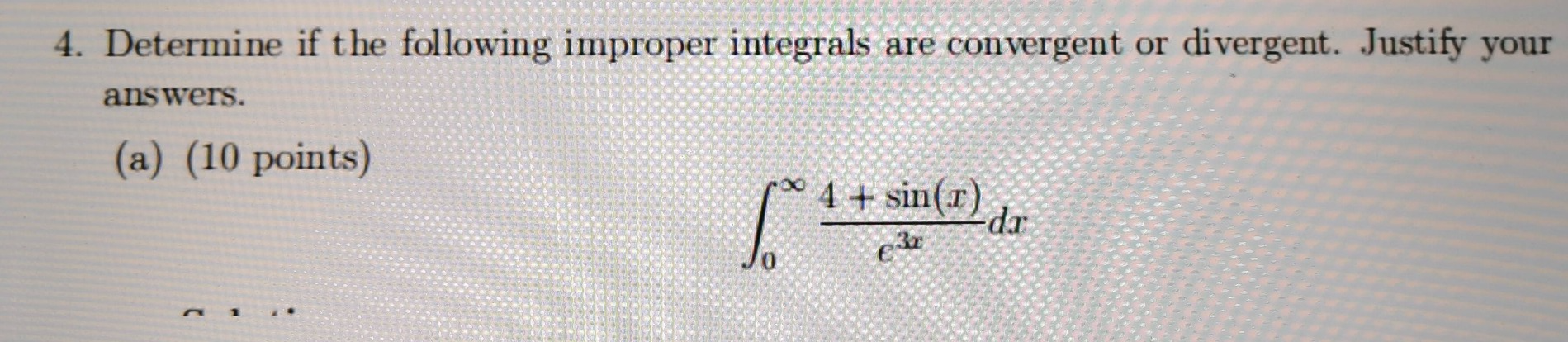
4. determine if the following improper integrals are convergent or divergent. justify your answers. (a) (10 points) ∫₀^∞ (4 + sin(x))/e³ˣ dx
Answer
Explanation:
Step1: Use comparison - test
We know that $- 1\leqslant\sin(x)\leqslant1$. So, $3\leqslant4 + \sin(x)\leqslant5$. Then, $\frac{4+\sin(x)}{e^{3x}}\leqslant\frac{5}{e^{3x}}$.
Step2: Evaluate $\int_{0}^{\infty}\frac{5}{e^{3x}}dx$
We rewrite $\frac{5}{e^{3x}}$ as $5e^{-3x}$. Then, $\int_{0}^{\infty}5e^{-3x}dx=\lim_{b\rightarrow\infty}\int_{0}^{b}5e^{-3x}dx$. Using the integral formula $\int e^{ax}dx=\frac{1}{a}e^{ax}+C$ ($a\neq0$), we have $\lim_{b\rightarrow\infty}\left[-\frac{5}{3}e^{-3x}\right]_{0}^{b}$.
Step3: Calculate the limit
$\lim_{b\rightarrow\infty}\left(-\frac{5}{3}e^{-3b}+\frac{5}{3}e^{0}\right)$. Since $\lim_{b\rightarrow\infty}e^{-3b}=0$, the value of $\lim_{b\rightarrow\infty}\left(-\frac{5}{3}e^{-3b}+\frac{5}{3}e^{0}\right)=\frac{5}{3}$.
Step4: Apply comparison - test conclusion
Since $\int_{0}^{\infty}\frac{5}{e^{3x}}dx$ converges and $\frac{4+\sin(x)}{e^{3x}}\leqslant\frac{5}{e^{3x}}$ for all $x\geqslant0$, by the comparison - test for improper integrals, $\int_{0}^{\infty}\frac{4 + \sin(x)}{e^{3x}}dx$ converges.
Answer:
The improper integral $\int_{0}^{\infty}\frac{4+\sin(x)}{e^{3x}}dx$ is convergent.