determine the following indefinite integrals:\n1. $int_{2}^{5}(-3v + 4)dv$\n2. $int_{-1}^{1}(t^{2}-2)dt$\n3…
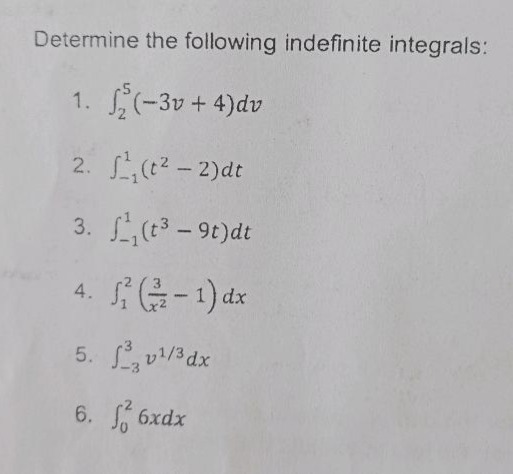
determine the following indefinite integrals:\n1. $int_{2}^{5}(-3v + 4)dv$\n2. $int_{-1}^{1}(t^{2}-2)dt$\n3. $int_{-1}^{1}(t^{3}-9t)dt$\n4. $int_{1}^{2}(\frac{3}{x^{2}}-1)dx$\n5. $int_{-3}^{3}v^{1/3}dx$\n6. $int_{0}^{2}6xdx$
Answer
Explanation:
Step1: Recall power - rule for integration
The power - rule for integration is $\int x^n dx=\frac{x^{n + 1}}{n+1}+C$ ($n\neq - 1$), and $\int kdx=kx + C$ where $k$ is a constant. Also, $\int(f(x)+g(x))dx=\int f(x)dx+\int g(x)dx$.
Step2: Solve $\int_{2}^{5}(-3v + 4)dv$
First, find the antiderivative of $-3v + 4$. The antiderivative of $-3v$ is $-3\times\frac{v^{2}}{2}=-\frac{3v^{2}}{2}$ and the antiderivative of $4$ is $4v$. Then, by the fundamental theorem of calculus $\int_{a}^{b}F^\prime(x)dx=F(b)-F(a)$. [ \begin{align*} \int_{2}^{5}(-3v + 4)dv&=\left[-\frac{3v^{2}}{2}+4v\right]_{2}^{5}\ &=\left(-\frac{3\times5^{2}}{2}+4\times5\right)-\left(-\frac{3\times2^{2}}{2}+4\times2\right)\ &=\left(-\frac{75}{2}+20\right)-\left(-6 + 8\right)\ &=\left(-\frac{75}{2}+20\right)-2\ &=-\frac{75}{2}+20 - 2\ &=-\frac{75}{2}+18\ &=\frac{-75 + 36}{2}\ &=-\frac{39}{2} \end{align*} ]
Step3: Solve $\int_{-1}^{1}(t^{2}-2)dt$
The antiderivative of $t^{2}$ is $\frac{t^{3}}{3}$ and the antiderivative of $-2$ is $-2t$. [ \begin{align*} \int_{-1}^{1}(t^{2}-2)dt&=\left[\frac{t^{3}}{3}-2t\right]_{-1}^{1}\ &=\left(\frac{1^{3}}{3}-2\times1\right)-\left(\frac{(-1)^{3}}{3}-2\times(-1)\right)\ &=\left(\frac{1}{3}-2\right)-\left(-\frac{1}{3}+2\right)\ &=\frac{1}{3}-2+\frac{1}{3}-2\ &=\frac{2}{3}-4\ &=\frac{2 - 12}{3}\ &=-\frac{10}{3} \end{align*} ]
Step4: Solve $\int_{-1}^{1}(t^{3}-9t)dt$
The antiderivative of $t^{3}$ is $\frac{t^{4}}{4}$ and the antiderivative of $-9t$ is $-\frac{9t^{2}}{2}$. [ \begin{align*} \int_{-1}^{1}(t^{3}-9t)dt&=\left[\frac{t^{4}}{4}-\frac{9t^{2}}{2}\right]_{-1}^{1}\ &=\left(\frac{1^{4}}{4}-\frac{9\times1^{2}}{2}\right)-\left(\frac{(-1)^{4}}{4}-\frac{9\times(-1)^{2}}{2}\right)\ &=\left(\frac{1}{4}-\frac{9}{2}\right)-\left(\frac{1}{4}-\frac{9}{2}\right)\ &=0 \end{align*} ]
Step5: Solve $\int_{1}^{2}\left(\frac{3}{x^{2}}-1\right)dx$
Rewrite $\frac{3}{x^{2}}$ as $3x^{-2}$. The antiderivative of $3x^{-2}$ is $3\times\frac{x^{-2 + 1}}{-2+1}=- \frac{3}{x}$ and the antiderivative of $-1$ is $-x$. [ \begin{align*} \int_{1}^{2}\left(\frac{3}{x^{2}}-1\right)dx&=\left[-\frac{3}{x}-x\right]_{1}^{2}\ &=\left(-\frac{3}{2}-2\right)-\left(-3 - 1\right)\ &=-\frac{3}{2}-2 + 3+1\ &=-\frac{3}{2}+2\ &=\frac{-3 + 4}{2}\ &=\frac{1}{2} \end{align*} ]
Step6: Solve $\int_{-3}^{3}v^{\frac{1}{3}}dv$
The antiderivative of $v^{\frac{1}{3}}$ is $\frac{v^{\frac{1}{3}+1}}{\frac{1}{3}+1}=\frac{3}{4}v^{\frac{4}{3}}$. [ \begin{align*} \int_{-3}^{3}v^{\frac{1}{3}}dv&=\left[\frac{3}{4}v^{\frac{4}{3}}\right]_{-3}^{3}\ &=\frac{3}{4}\times3^{\frac{4}{3}}-\frac{3}{4}\times(-3)^{\frac{4}{3}}\ &=0 \end{align*} ]
Step7: Solve $\int_{0}^{2}6xdx$
The antiderivative of $6x$ is $6\times\frac{x^{2}}{2}=3x^{2}$. [ \begin{align*} \int_{0}^{2}6xdx&=\left[3x^{2}\right]_{0}^{2}\ &=3\times2^{2}-3\times0^{2}\ &=12 \end{align*} ]
Answer:
- $-\frac{39}{2}$
- $-\frac{10}{3}$
- $0$
- $\frac{1}{2}$
- $0$
- $12$