determine the following limit. lim (2x^7 - 6x^6 + 1) as x→ -∞ select the correct choice below and, if…
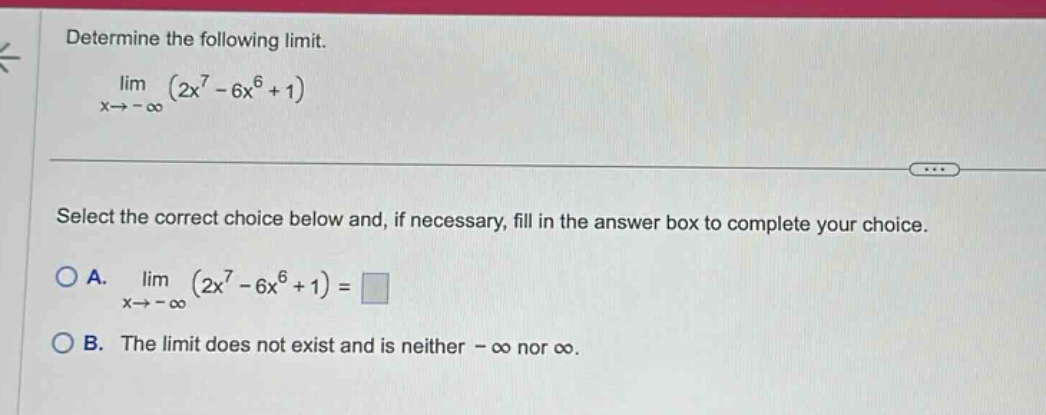
determine the following limit. lim (2x^7 - 6x^6 + 1) as x→ -∞ select the correct choice below and, if necessary, fill in the answer box to complete your choice. a. lim (2x^7 - 6x^6 + 1) as x→ -∞ = b. the limit does not exist and is neither -∞ nor ∞.
Answer
Explanation:
Step1: Analyze the leading - term
For the polynomial function (f(x)=2x^{7}-6x^{6}+1), the leading - term is (2x^{7}) as the degree of the polynomial is 7 and the leading coefficient is 2. When (x\to-\infty), the behavior of the polynomial is determined by the leading - term.
Step2: Evaluate the limit of the leading - term
We know that for (y = ax^{n}), when (n) is odd and (a>0), (\lim_{x\to-\infty}ax^{n}=-\infty). Here (a = 2) and (n = 7) (odd). So (\lim_{x\to-\infty}2x^{7}=-\infty), and (\lim_{x\to-\infty}(- 6x^{6})=-\infty), (\lim_{x\to-\infty}1 = 1). Since the leading - term dominates, (\lim_{x\to-\infty}(2x^{7}-6x^{6}+1)=\lim_{x\to-\infty}2x^{7}=-\infty).
Answer:
A. (\lim_{x\to-\infty}(2x^{7}-6x^{6}+1)=-\infty)