determine if the following series converges or diverges. use any method, and give reasons for your answer…
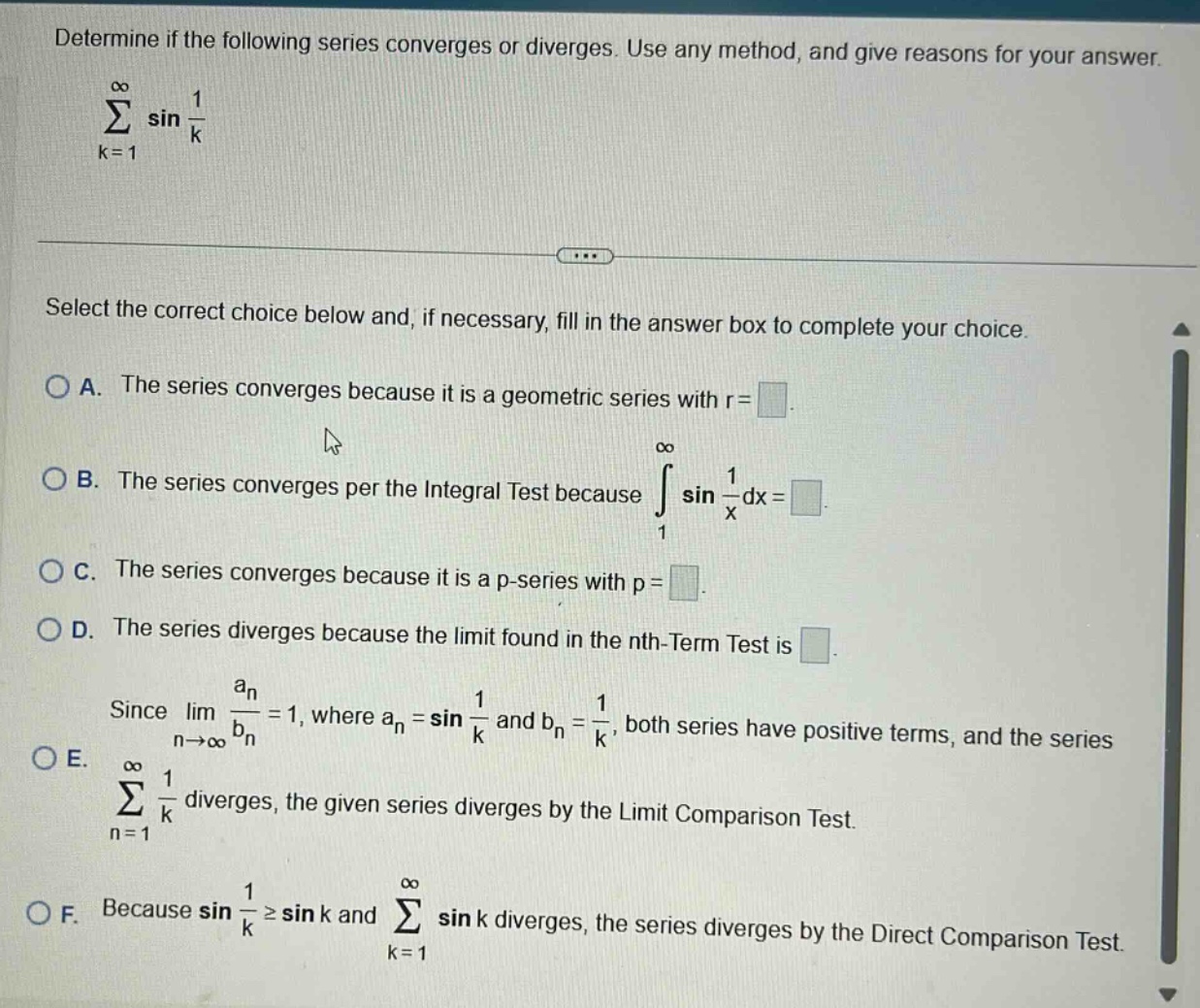
determine if the following series converges or diverges. use any method, and give reasons for your answer. \n∑k = 1 to ∞ sin(1/k)\nselect the correct choice below and, if necessary, fill in the answer box to complete your choice.\na. the series converges because it is a geometric series with r = \n\nb. the series converges per the integral test because ∫1 to ∞ sin(1/x)dx = \n\nc. the series converges because it is a p - series with p = \n\nd. the series diverges because the limit found in the nth - term test is \n\nsince limn→∞ an/bn = 1, where an = sin(1/k) and bn = 1/k, both series have positive terms, and the series ∑n = 1 to ∞ 1/k diverges, the given series diverges by the limit comparison test.\ne. \n\nf. because sin(1/k)≥sin k and ∑k = 1 to ∞ sin k diverges, the series diverges by the direct comparison test.
Answer
Explanation:
Step1: Recall limit - comparison test
For two series $\sum a_n$ and $\sum b_n$ with $a_n\geq0$, $b_n > 0$ for all $n$, if $\lim_{n\rightarrow\infty}\frac{a_n}{b_n}=L$, where $0 < L<\infty$, then either both series converge or both series diverge. Let $a_n=\sin\frac{1}{n}$ and $b_n = \frac{1}{n}$.
Step2: Calculate the limit
We know that $\lim_{x\rightarrow0}\frac{\sin x}{x}=1$. Let $x = \frac{1}{n}$, as $n\rightarrow\infty$, $x\rightarrow0$. So, $\lim_{n\rightarrow\infty}\frac{\sin\frac{1}{n}}{\frac{1}{n}} = 1$.
Step3: Analyze the series $\sum b_n$
The series $\sum_{n = 1}^{\infty}\frac{1}{n}$ is the harmonic series, and it is a well - known fact that the harmonic series $\sum_{n=1}^{\infty}\frac{1}{n}$ diverges.
Step4: Apply the limit - comparison test
Since $\lim_{n\rightarrow\infty}\frac{\sin\frac{1}{n}}{\frac{1}{n}}=1$, $a_n=\sin\frac{1}{n}\geq0$ for $n\geq1$, $b_n=\frac{1}{n}>0$ for $n\geq1$, and $\sum_{n = 1}^{\infty}\frac{1}{n}$ diverges, by the Limit Comparison Test, the series $\sum_{k = 1}^{\infty}\sin\frac{1}{k}$ diverges.
Answer:
E. The series diverges because $\lim_{n\rightarrow\infty}\frac{a_n}{b_n}=1$, where $a_n=\sin\frac{1}{k}$ and $b_n=\frac{1}{k}$, both series have positive terms, and the series $\sum_{n = 1}^{\infty}\frac{1}{k}$ diverges, the given series diverges by the Limit Comparison Test.