determine if the function below has a horizontal or a slant asymptote, and explain why. f(x)=(-8 + 10x…
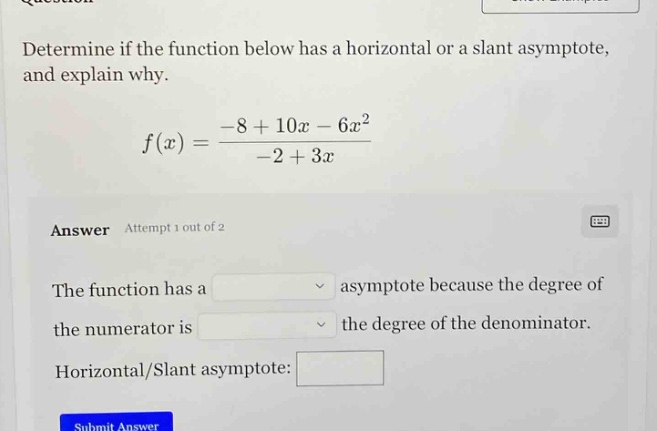
determine if the function below has a horizontal or a slant asymptote, and explain why. f(x)=(-8 + 10x - 6x^2)/(-2 + 3x) answer attempt 1 out of 2 the function has a asymptote because the degree of the numerator is the degree of the denominator. horizontal/slant asymptote:
Answer
Explanation:
Step1: Identify degrees of numerator and denominator
The degree of the numerator $-8 + 10x-6x^{2}$ is 2 (highest power of $x$ is 2), and the degree of the denominator $-2 + 3x$ is 1 (highest power of $x$ is 1). Since $2>1$, the degree of the numerator is greater than the degree of the denominator.
Step2: Determine the type of asymptote
When the degree of the numerator is exactly one - degree greater than the degree of the denominator, the function has a slant asymptote. We can find the slant asymptote by long - dividing the numerator by the denominator. Dividing $-6x^{2}+10x - 8$ by $3x-2$: [ \begin{align*} \frac{-6x^{2}+10x - 8}{3x-2}&=- 2x + 2-\frac{4}{3x - 2} \end{align*} ] As $x\to\pm\infty$, $\frac{-4}{3x - 2}\to0$. The slant asymptote is $y=-2x + 2$.
Answer:
The function has a slant asymptote because the degree of the numerator is greater than the degree of the denominator. Horizontal/Slant asymptote: $y=-2x + 2$