determine from the given graph whether the function has any absolute extreme values on (a, b). determine…
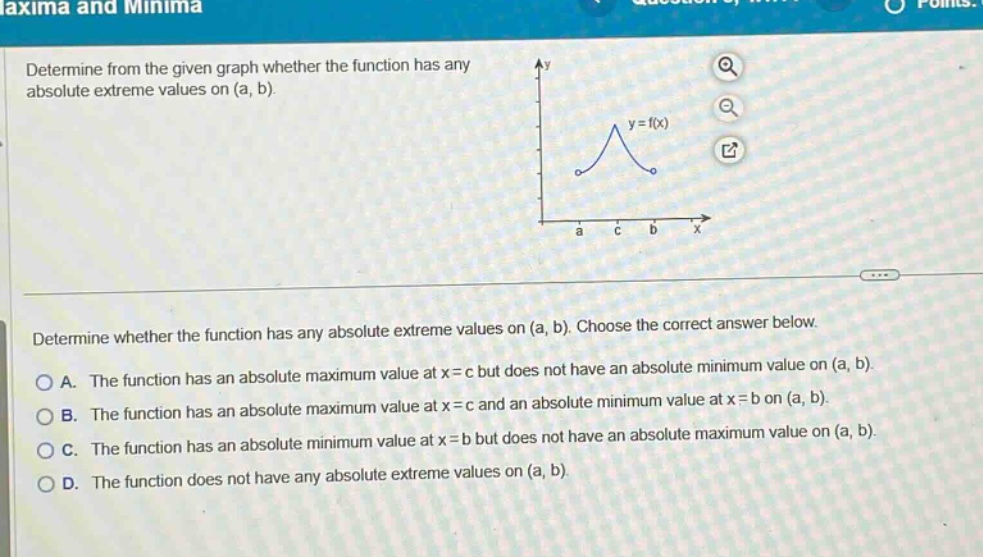
determine from the given graph whether the function has any absolute extreme values on (a, b). determine whether the function has any absolute extreme values on (a, b). choose the correct answer below. a. the function has an absolute maximum value at x = c but does not have an absolute minimum value on (a, b). b. the function has an absolute maximum value at x = c and an absolute minimum value at x = b on (a, b). c. the function has an absolute minimum value at x = b but does not have an absolute maximum value on (a, b). d. the function does not have any absolute extreme values on (a, b).
Answer
Explanation:
Step1: Analyze the graph
The function $y = f(x)$ on the open - interval $(a,b)$ has a peak at $x = c$. The value of the function at $x = c$ is greater than the values of the function at all other points in the interval $(a,b)$. So, it has an absolute maximum at $x = c$.
Step2: Check for minimum
The function is an open - interval $(a,b)$. As we approach the endpoints $a$ and $b$, the function values do not reach a single smallest value in the interval $(a,b)$. So, there is no absolute minimum.
Answer:
A. The function has an absolute maximum value at $x = c$ but does not have an absolute minimum value on $(a,b)$