determine the horizontal asymptote of the function. if none exists, state that fact. f(x)=(4x^7 + 2x^5…
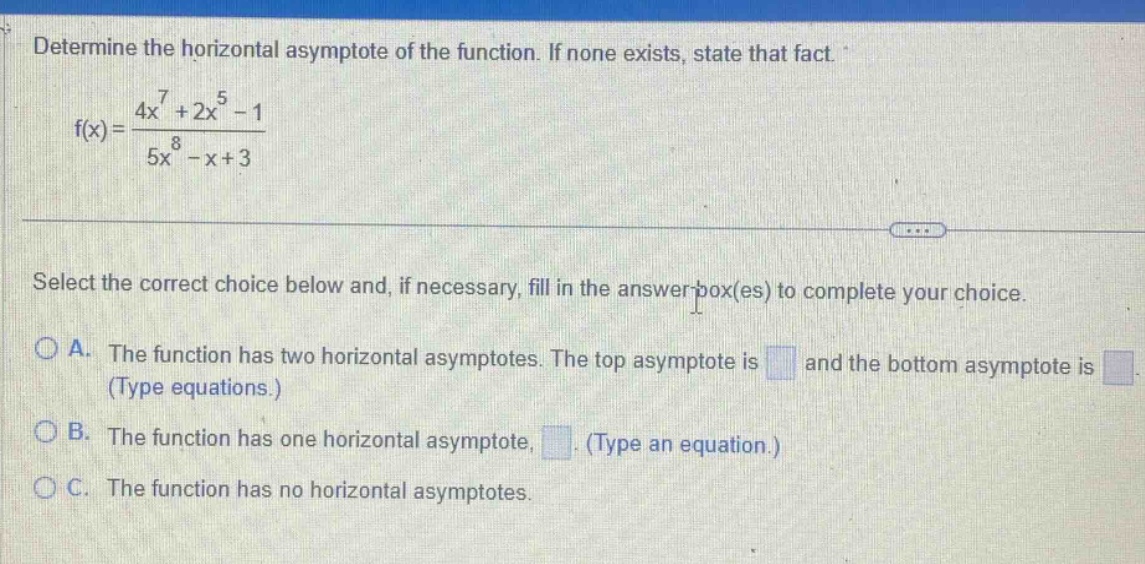
determine the horizontal asymptote of the function. if none exists, state that fact. f(x)=(4x^7 + 2x^5 - 1)/(5x^8 - x + 3) select the correct choice below and, if necessary, fill in the answer - box(es) to complete your choice. a. the function has two horizontal asymptotes. the top asymptote is and the bottom asymptote is (type equations.) b. the function has one horizontal asymptote, . (type an equation.) c. the function has no horizontal asymptotes.
Answer
Explanation:
Step1: Identify degrees of polynomials
The degree of the numerator $4x^{7}+2x^{5}-1$ is $n = 7$, and the degree of the denominator $5x^{8}-x + 3$ is $m=8$.
Step2: Apply horizontal - asymptote rule
When $n<m$, the horizontal asymptote of the rational function $y = \frac{f(x)}{g(x)}$ (where $f(x)$ is the numerator and $g(x)$ is the denominator) is $y = 0$. Here, since $7<8$, the horizontal asymptote is $y = 0$.
Answer:
B. The function has one horizontal asymptote, $y = 0$.