determine the horizontal asymptote of the graph of the function. g(x)=(x³ - 3x² + x - 3)/(x² - 17) select…
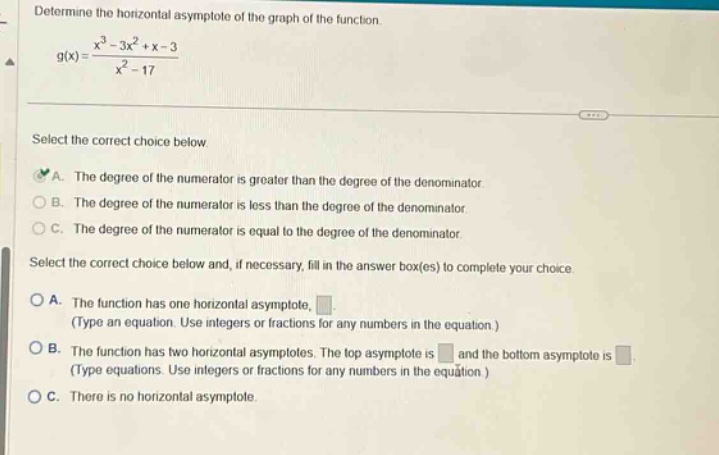
determine the horizontal asymptote of the graph of the function. g(x)=(x³ - 3x² + x - 3)/(x² - 17) select the correct choice below a. the degree of the numerator is greater than the degree of the denominator. b. the degree of the numerator is less than the degree of the denominator. c. the degree of the numerator is equal to the degree of the denominator. select the correct choice below and, if necessary, fill in the answer box(es) to complete your choice. a. the function has one horizontal asymptote, . (type an equation. use integers or fractions for any numbers in the equation.) b. the function has two horizontal asymptotes. the top asymptote is and the bottom asymptote is . (type equations. use integers or fractions for any numbers in the equation.) c. there is no horizontal asymptote.
Answer
Answer:
First part: A. The degree of the numerator is greater than the degree of the denominator. Second part: C. There is no horizontal asymptote.
Explanation:
Step1: Determine degrees
Degree of numerator of $g(x)=\frac{x^{3}-3x^{2}+x - 3}{x^{2}-17}$: For the numerator $x^{3}-3x^{2}+x - 3$, the highest - power of $x$ is 3, so degree $n = 3$. For the denominator $x^{2}-17$, the highest - power of $x$ is 2, so degree $m = 2$. Since $n=3>m = 2$.
Step2: Recall asymptote rule
If the degree of the numerator $n$ is greater than the degree of the denominator $m$ in a rational function $y=\frac{f(x)}{g(x)}$, then there is no horizontal asymptote.