determine all the x - intercepts, asymptotes, and points of discontinuity of the given function. if there is…
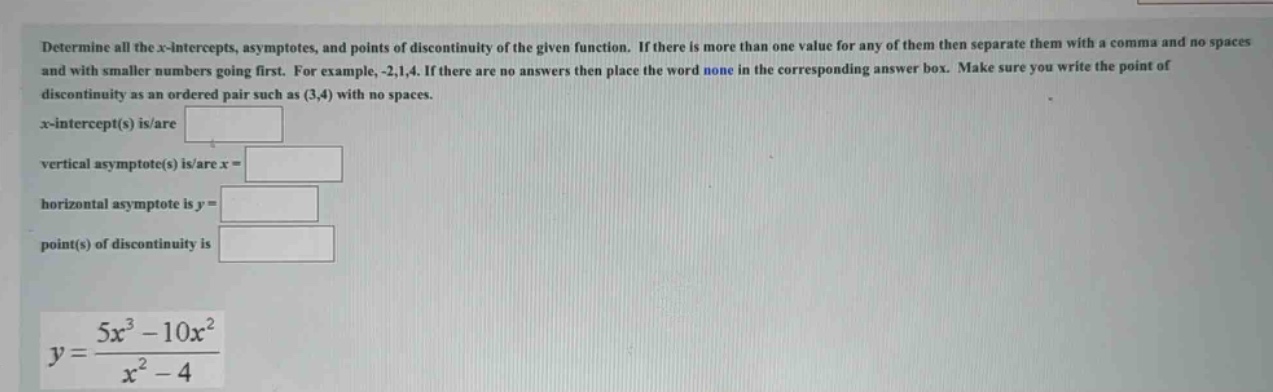
determine all the x - intercepts, asymptotes, and points of discontinuity of the given function. if there is more than one value for any of them then separate them with a comma and no spaces and with smaller numbers going first. for example, -2,1,4. if there are no answers then place the word none in the corresponding answer box. make sure you write the point of discontinuity as an ordered pair such as (3,4) with no spaces. x - intercept(s) is/are vertical asymptote(s) is/are x = horizontal asymptote is y = point(s) of discontinuity is y = (5x^3 - 10x^2)/(x^2 - 4)
Answer
Explanation:
Step1: Find x - intercepts
Set $y = 0$, so $\frac{5x^{3}-10x^{2}}{x^{2}-4}=0$. Since a fraction is 0 when the numerator is 0 and the denominator is non - zero. Solve $5x^{3}-10x^{2}=5x^{2}(x - 2)=0$. We get $x = 0,x = 2$. When $x = 0$ and $x = 2$, the denominator $x^{2}-4=(x + 2)(x - 2)\neq0$ for $x = 0$ and is 0 for $x = 2$ but we consider the zero of the numerator first. So the $x$-intercepts are $0,2$.
Step2: Find vertical asymptotes
Set the denominator equal to 0, $x^{2}-4=(x + 2)(x - 2)=0$. Solving gives $x=-2,x = 2$.
Step3: Find horizontal asymptote
Since the degree of the numerator $n = 3$ and the degree of the denominator $m = 2$ ($n>m$), there is no horizontal asymptote.
Step4: Find points of discontinuity
The function is discontinuous at the values of $x$ that make the denominator 0. Factor the function $y=\frac{5x^{2}(x - 2)}{(x + 2)(x - 2)}$. After canceling out the common factor $(x - 2)$ (for $x\neq2$), the function has a removable discontinuity at $x = 2$ and a non - removable discontinuity at $x=-2$. The removable discontinuity at $x = 2$ can be found by substituting $x = 2$ into the simplified function $y=\frac{5x^{2}}{x + 2}$ (after canceling $x - 2$), $y=\frac{5\times2^{2}}{2+2}=5$. So the point of discontinuity is $(2,5)$ and the non - removable discontinuity at $x=-2$ is a vertical asymptote.
Answer:
x - intercept(s): 0,2 vertical asymptote(s): $x=-2$ horizontal asymptote: none point(s) of discontinuity: $(2,5)$