determine an interval for which the function m(x) is decreasing. m(x)=4/(x^2 - 3x) a (0,3) b (-∞,∞) c (3,∞)…
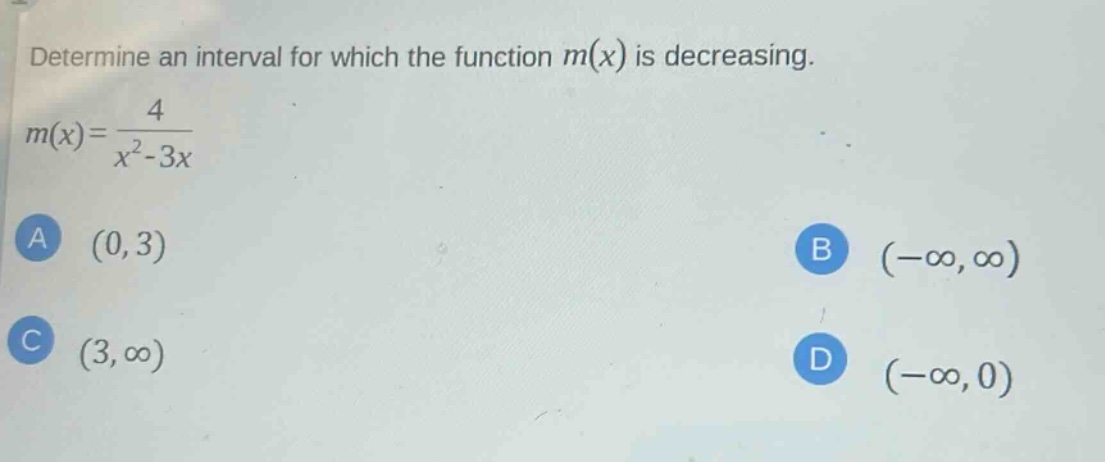
determine an interval for which the function m(x) is decreasing. m(x)=4/(x^2 - 3x) a (0,3) b (-∞,∞) c (3,∞) d (-∞,0)
Answer
Explanation:
Step1: Find the derivative of (m(x))
First, rewrite (m(x)=\frac{4}{x^{2}-3x}=4(x^{2}-3x)^{- 1}). Using the chain - rule ((u^n)^\prime = nu^{n - 1}u^\prime), where (u = x^{2}-3x) and (n=-1). The derivative of (u=x^{2}-3x) is (u^\prime=2x - 3). Then (m^\prime(x)=4\times(-1)\times(x^{2}-3x)^{-2}\times(2x - 3)=-\frac{4(2x - 3)}{(x^{2}-3x)^{2}}).
Step2: Determine where (m^\prime(x)<0)
The denominator ((x^{2}-3x)^{2}=(x(x - 3))^{2}>0) for all (x\neq0) and (x\neq3). We only need to consider the sign of the numerator. Set the numerator (-4(2x - 3)<0). Solving (2x-3>0) (since we divide both sides by - 4 and reverse the inequality sign), we get (x>\frac{3}{2}). Also, we need to consider the domain of (m(x)), which is (x\neq0) and (x\neq3). Analyzing the function, when (x>3), (m^\prime(x)<0).
Answer:
C. ((3,\infty))