determine the interval where g(x) = tan (-2x) is concave up on the domain (0, π).\n○ π/4 < x < π/2 and 3π/4…
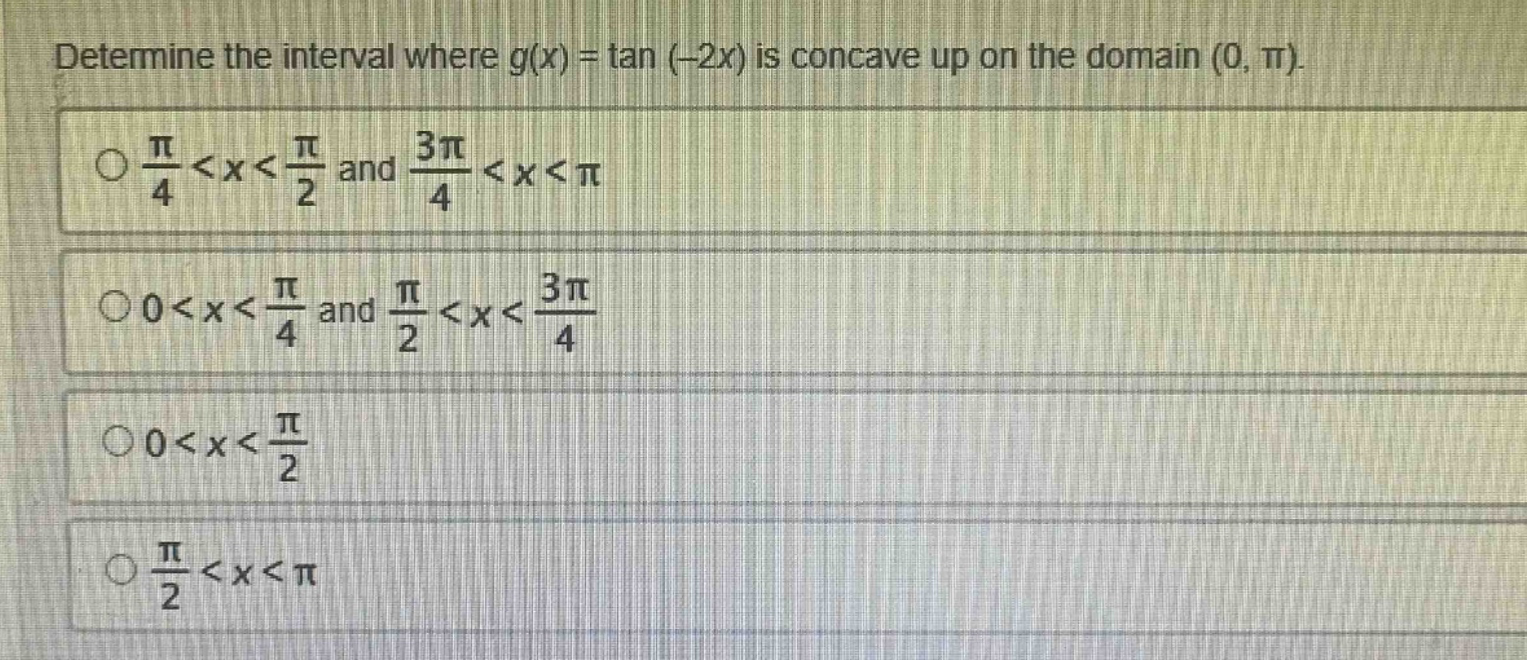
determine the interval where g(x) = tan (-2x) is concave up on the domain (0, π).\n○ π/4 < x < π/2 and 3π/4 < x < π\n○ 0 < x < π/4 and π/2 < x < 3π/4\n○ 0 < x < π/2\n○ π/2 < x < π
Answer
Explanation:
Step1: Recall the double - angle formula for tangent
We know that (g(x)=\tan(- 2x)=-\tan(2x)). The second - derivative of (y = \tan(u)) with respect to (x) using the chain - rule. First, if (y=\tan(u)) and (u = 2x), then (\frac{dy}{dx}=\sec^{2}(u)\cdot\frac{du}{dx}). Since (u = 2x) and (\frac{du}{dx}=2), (\frac{d}{dx}\tan(2x)=2\sec^{2}(2x)). Then, we find the second - derivative. Using the chain - rule again, if (y = 2\sec^{2}(2x)=2(\sec(2x))^{2}), let (v=\sec(2x)), so (y = 2v^{2}). (\frac{dy}{dv}=4v) and (\frac{dv}{dx}=2\sec(2x)\tan(2x)). Then (\frac{d^{2}}{dx^{2}}\tan(2x)=8\sec^{2}(2x)\tan(2x)). So, (\frac{d^{2}}{dx^{2}}(-\tan(2x))=- 8\sec^{2}(2x)\tan(2x)).
Step2: Determine where the second - derivative is positive
The function (g(x)) is concave up when (g''(x)>0). Since (\sec^{2}(2x)>0) for all (x) in the domain of (\tan(2x)) (because (\sec(2x)=\frac{1}{\cos(2x)}) and (\sec^{2}(2x)=\frac{1}{\cos^{2}(2x)}>0)), we need to find where (-8\sec^{2}(2x)\tan(2x)>0), which is equivalent to (\tan(2x)<0) (dividing both sides by (- 8\sec^{2}(2x)) and reversing the inequality sign).
Step3: Solve the inequality for (x) in the given domain
We know that (\tan(2x)<0) when (\frac{\pi}{2}+k\pi<2x<\pi + k\pi), (k\in\mathbb{Z}). Dividing through by 2 gives (\frac{\pi}{4}+\frac{k\pi}{2}<x<\frac{\pi}{2}+\frac{k\pi}{2}), (k\in\mathbb{Z}). In the domain ((0,\pi)), when (k = 0), (\frac{\pi}{4}<x<\frac{\pi}{2}); when (k = 1), (\frac{3\pi}{4}<x<\pi).
Answer:
(\frac{\pi}{4}<x<\frac{\pi}{2}) and (\frac{3\pi}{4}<x<\pi)