determine the interval where g(x) = tan (-2x) is concave up on the domain (-π, 0).\n-π/2 < x < 0\n-π < x <…
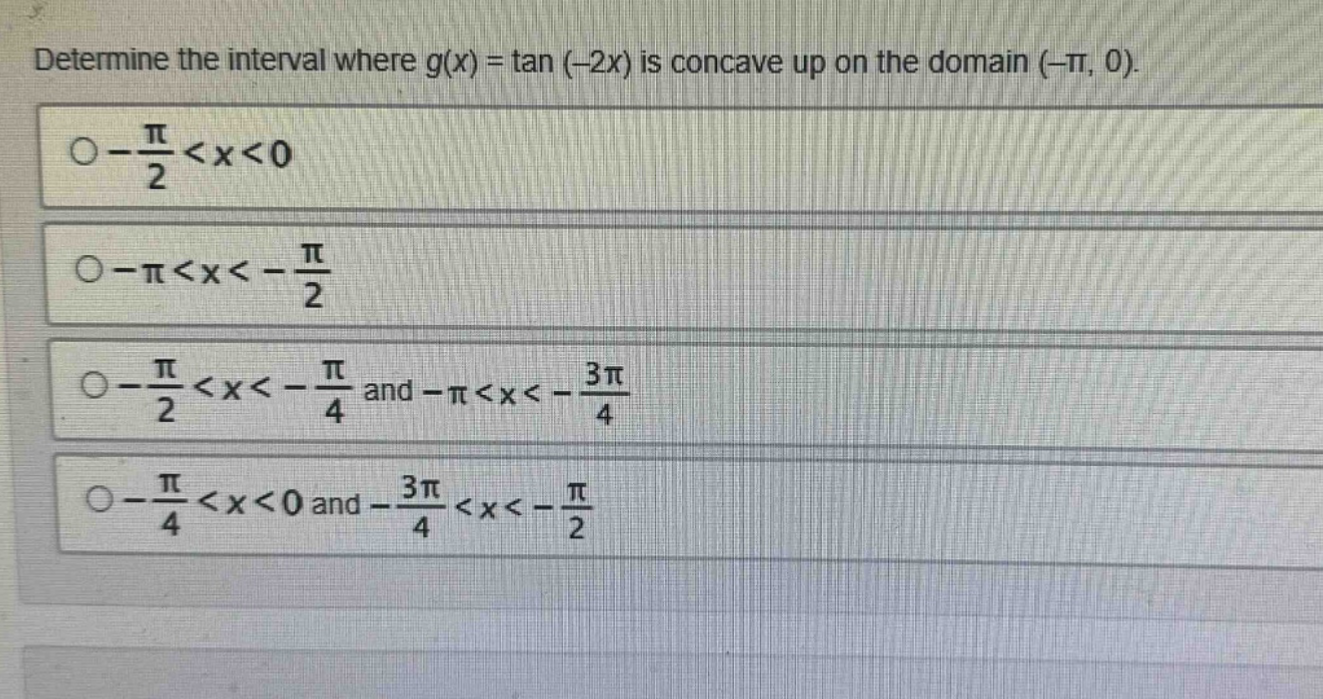
determine the interval where g(x) = tan (-2x) is concave up on the domain (-π, 0).\n-π/2 < x < 0\n-π < x < -π/2\n-π/2 < x < -π/4 and -π < x < -3π/4\n-π/4 < x < 0 and -3π/4 < x < -π/2
Answer
Explanation:
Step1: Recall the derivative of tangent function
The derivative of $y = \tan(u)$ is $y'=\sec^{2}(u)\cdot u'$. For $g(x)=\tan(- 2x)$, by the chain - rule, $g'(x)=\sec^{2}(-2x)\cdot(-2)=-2\sec^{2}(-2x)$.
Step2: Find the second - derivative
Recall that $\sec^{2}(u)=\frac{1}{\cos^{2}(u)}$. Using the chain - rule again, if $y = - 2\sec^{2}(-2x)=-2(\sec(-2x))^{2}$, then $y'=-4\sec(-2x)\cdot\sec(-2x)\tan(-2x)\cdot(-2)=8\sec^{2}(-2x)\tan(-2x)$.
Step3: Recall the condition for concavity
A function $y = g(x)$ is concave up when $g''(x)>0$. Since $\sec^{2}(-2x)>0$ for all $x$ in the domain of $\tan(-2x)$ (because $\sec t=\frac{1}{\cos t}$ and $\cos t\neq0$ in the domain of $\tan t$), we need to find when $\tan(-2x)>0$. Let $t=-2x$. The tangent function $y = \tan(t)$ is positive in the intervals $(k\pi,k\pi+\frac{\pi}{2})$ for $k\in\mathbb{Z}$. So, $\tan(-2x)>0$ when $k\pi<-2x<k\pi+\frac{\pi}{2}$.
Step4: Solve the inequality for $x$
Divide the inequality $k\pi<-2x<k\pi+\frac{\pi}{2}$ by $- 2$. When dividing by a negative number, the direction of the inequality signs changes. We get $-\frac{k\pi}{2}-\frac{\pi}{4}<x<-\frac{k\pi}{2}$.
Step5: Find the intervals in the domain $(-\pi,0)$
When $k = 1$, $-\frac{\pi}{2}-\frac{\pi}{4}<x<-\frac{\pi}{2}$, i.e., $-\frac{3\pi}{4}<x<-\frac{\pi}{2}$. When $k = 0$, $-\frac{\pi}{4}<x<0$.
Answer:
$-\frac{\pi}{4}<x<0$ and $-\frac{3\pi}{4}<x<-\frac{\pi}{2}$