determine the intervals on which the following function is concave up or concave down. identify any…
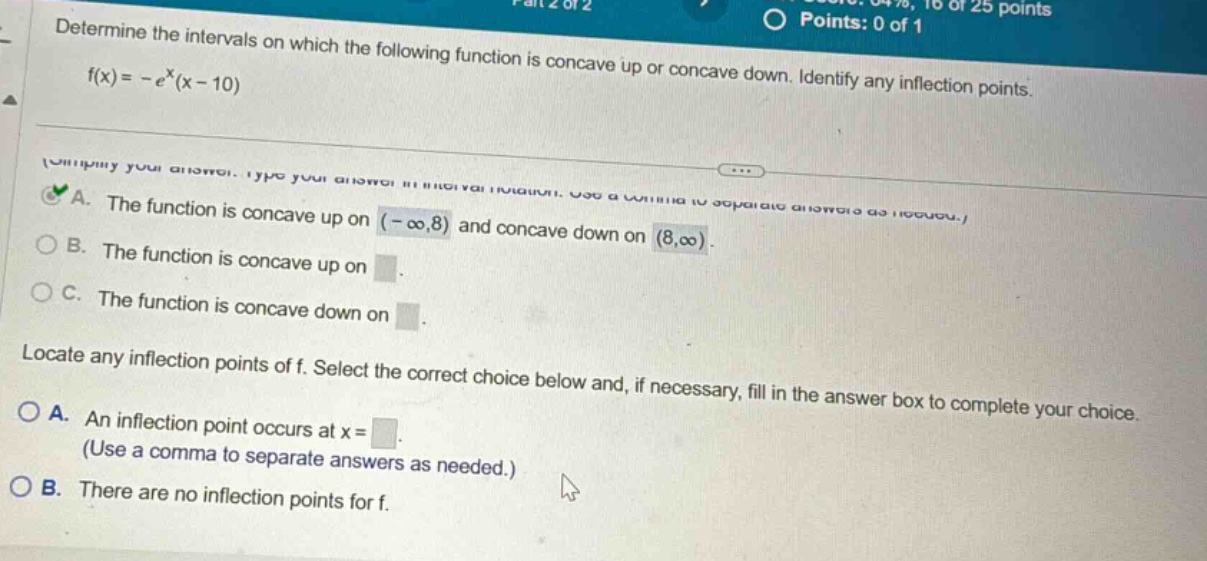
determine the intervals on which the following function is concave up or concave down. identify any inflection points. f(x)= -e^x(x - 10) a. the function is concave up on (-∞,8) and concave down on (8,∞). b. the function is concave up on. c. the function is concave down on. locate any inflection points of f. select the correct choice below and, if necessary, fill in the answer box to complete your choice. a. an inflection point occurs at x=. (use a comma to separate answers as needed.) b. there are no inflection points for f.
Answer
Explanation:
Step1: Find the first - derivative
Use the product rule $(uv)^\prime = u^\prime v+uv^\prime$, where $u=-e^{x}$ and $v = x - 10$. $u^\prime=-e^{x}$, $v^\prime = 1$. $f^\prime(x)=-e^{x}(x - 10)-e^{x}=-e^{x}(x - 10 + 1)=-e^{x}(x - 9)$.
Step2: Find the second - derivative
Again use the product rule. Let $u=-e^{x}$ and $v=x - 9$. $u^\prime=-e^{x}$, $v^\prime = 1$. $f^{\prime\prime}(x)=-e^{x}(x - 9)-e^{x}=-e^{x}(x - 9+1)=-e^{x}(x - 8)$.
Step3: Find where $f^{\prime\prime}(x)>0$ (concave up)
Since $e^{x}>0$ for all $x\in R$, we solve $-e^{x}(x - 8)>0$. Divide both sides by $-e^{x}$ (and reverse the inequality sign because $-e^{x}<0$). We get $x - 8<0$, so $x<8$. The function is concave up on $(-\infty,8)$.
Step4: Find where $f^{\prime\prime}(x)<0$ (concave down)
Solve $-e^{x}(x - 8)<0$. Divide both sides by $-e^{x}$ (reverse the inequality sign). We get $x - 8>0$, so $x>8$. The function is concave down on $(8,\infty)$.
Step5: Find inflection points
Set $f^{\prime\prime}(x) = 0$. Since $e^{x}\neq0$ for all $x\in R$, we set $x - 8=0$. So $x = 8$ is the inflection point.
Answer:
The function is concave up on $(-\infty,8)$ and concave down on $(8,\infty)$. An inflection point occurs at $x = 8$. A. The function is concave up on $(-\infty,8)$ and concave down on $(8,\infty)$. A. An inflection point occurs at $x = 8$.