determine the intervals on which the following function is concave up or concave down. identify any…
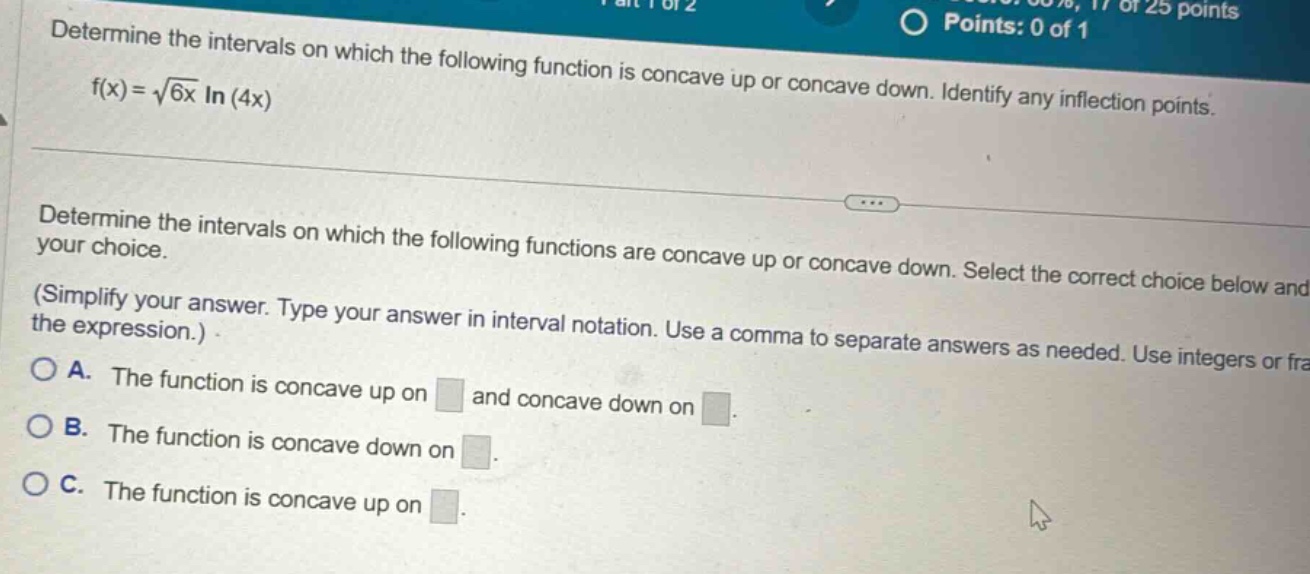
determine the intervals on which the following function is concave up or concave down. identify any inflection points. f(x)=√(6x) ln(4x) determine the intervals on which the following functions are concave up or concave down. select the correct choice below and your choice. (simplify your answer. type your answer in interval notation. use a comma to separate answers as needed. use integers or fra o a. the function is concave up on and concave down on. o b. the function is concave down on. o c. the function is concave up on.
Answer
Explanation:
Step1: Find the domain
For $y = \sqrt{6x}\ln(4x)$, we need $6x\geq0$ and $4x>0$. So the domain is $x > 0$.
Step2: Use product - rule to find the first - derivative
If $y = u\cdot v$ where $u=\sqrt{6x}=(6x)^{\frac{1}{2}}$ and $v = \ln(4x)$. $u^\prime=\frac{1}{2}(6x)^{-\frac{1}{2}}\cdot6=\frac{3}{\sqrt{6x}}$ and $v^\prime=\frac{1}{x}$. By the product - rule $y^\prime=u^\prime v+uv^\prime=\frac{3\ln(4x)}{\sqrt{6x}}+\frac{\sqrt{6x}}{x}=\frac{3\ln(4x)}{\sqrt{6x}}+\frac{\sqrt{6}}{\sqrt{x}}$.
Step3: Use quotient - rule and product - rule to find the second - derivative
Let $y^\prime=\frac{3\ln(4x)}{\sqrt{6x}}+\frac{\sqrt{6}}{\sqrt{x}}$. For $y_1=\frac{3\ln(4x)}{\sqrt{6x}}$, by the quotient - rule $\left(\frac{u}{v}\right)^\prime=\frac{u^\prime v - uv^\prime}{v^{2}}$, where $u = 3\ln(4x)$, $u^\prime=\frac{3}{x}$, $v=\sqrt{6x}$, $v^\prime=\frac{3}{\sqrt{6x}}$. $y_1^\prime=\frac{\frac{3}{x}\cdot\sqrt{6x}-3\ln(4x)\cdot\frac{3}{\sqrt{6x}}}{6x}=\frac{3\sqrt{6x}\cdot\sqrt{6x}-9x\ln(4x)}{6x\sqrt{6x}}=\frac{18x - 9x\ln(4x)}{6x\sqrt{6x}}=\frac{3-\frac{3}{2}\ln(4x)}{\sqrt{6x}}$. For $y_2=\frac{\sqrt{6}}{\sqrt{x}}=\sqrt{6}x^{-\frac{1}{2}}$, $y_2^\prime=-\frac{\sqrt{6}}{2}x^{-\frac{3}{2}}$. $y^{\prime\prime}=y_1^\prime + y_2^\prime=\frac{3-\frac{3}{2}\ln(4x)}{\sqrt{6x}}-\frac{\sqrt{6}}{2x\sqrt{x}}$. Set $y^{\prime\prime}=0$ to find inflection points. $\frac{3-\frac{3}{2}\ln(4x)}{\sqrt{6x}}-\frac{\sqrt{6}}{2x\sqrt{x}} = 0$. First, get a common denominator $2x\sqrt{6x}$. $\frac{2x(3-\frac{3}{2}\ln(4x))- 6}{2x\sqrt{6x}}=0$. $6x - 3x\ln(4x)-6 = 0$. $2x - x\ln(4x)-2 = 0$. Let $t = 4x$, then $x=\frac{t}{4}$, and the equation becomes $\frac{t}{2}-\frac{t}{4}\ln(t)-2 = 0$. $2t - t\ln(t)-8 = 0$. We can also rewrite $y^{\prime\prime}=\frac{3-\frac{3}{2}\ln(4x)}{\sqrt{6x}}-\frac{\sqrt{6}}{2x\sqrt{x}}=\frac{6x - 3x\ln(4x)-6}{2x\sqrt{6x}}$. Set $y^{\prime\prime}=0$, so $6x - 3x\ln(4x)-6 = 0$ or $2x - x\ln(4x)-2 = 0$. Using a graphing utility or numerical methods (e.g., Newton - Raphson method), we find that the root of $2x - x\ln(4x)-2 = 0$ is approximately $x\approx1.35$.
Step4: Test intervals
Choose a test point in the interval $(0,1.35)$, say $x = 1$. $y^{\prime\prime}(1)=\frac{3-\frac{3}{2}\ln(4)}{\sqrt{6}}-\frac{\sqrt{6}}{2}>0$. Choose a test point in the interval $(1.35,\infty)$, say $x = 2$. $y^{\prime\prime}(2)=\frac{3-\frac{3}{2}\ln(8)}{\sqrt{12}}-\frac{\sqrt{6}}{4\sqrt{2}}<0$.
Answer:
A. The function is concave up on $(0, \frac{e^{2}}{4})$ and concave down on $(\frac{e^{2}}{4},\infty)$.