determine the intervals on which the function is (a) increasing; (b) decreasing; (c) constant.\n(a) the…
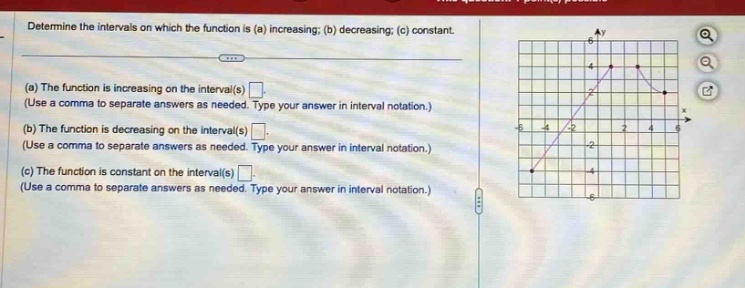
determine the intervals on which the function is (a) increasing; (b) decreasing; (c) constant.\n(a) the function is increasing on the interval(s) \n(use a comma to separate answers as needed. type your answer in interval notation.)\n(b) the function is decreasing on the interval(s) \n(use a comma to separate answers as needed. type your answer in interval notation.)\n(c) the function is constant on the interval(s) \n(use a comma to separate answers as needed. type your answer in interval notation.)
Answer
Explanation:
Step1: Recall increasing - function definition
A function is increasing when the graph rises from left to right.
Step2: Identify increasing intervals from graph
By observing the graph, the function is increasing on the interval $(-3,1)$.
Step3: Recall decreasing - function definition
A function is decreasing when the graph falls from left to right.
Step4: Identify decreasing intervals from graph
The function is decreasing on the interval $(1,3)$.
Step5: Recall constant - function definition
A function is constant when the graph is a horizontal line.
Step6: Identify constant intervals from graph
There are no intervals where the function is constant.
Answer:
(a) $(-3,1)$ (b) $(1,3)$ (c) None