determine the intervals on which the function is (a) increasing; (b) decreasing; (c) constant.\n(a) the…
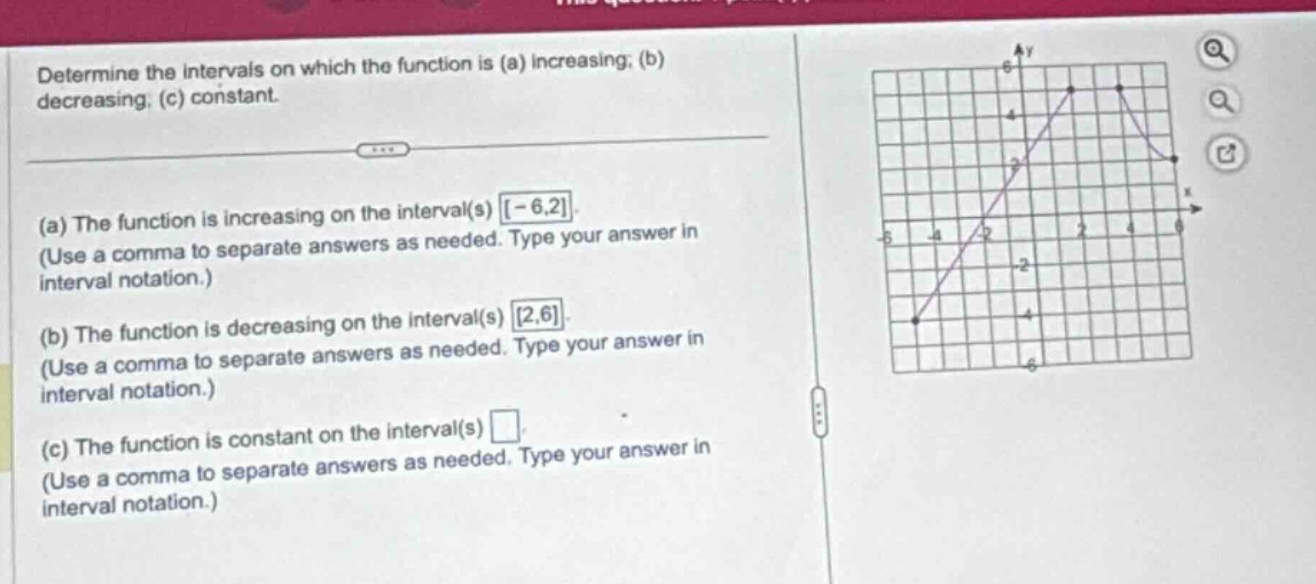
determine the intervals on which the function is (a) increasing; (b) decreasing; (c) constant.\n(a) the function is increasing on the interval(s) -6,2. (use a comma to separate answers as needed. type your answer in interval notation.)\n(b) the function is decreasing on the interval(s) 2,6. (use a comma to separate answers as needed. type your answer in interval notation.)\n(c) the function is constant on the interval(s) . (use a comma to separate answers as needed. type your answer in interval notation.)
Answer
Explanation:
Step1: Recall function behavior definitions
A function is increasing when the y - values increase as x increases, decreasing when y - values decrease as x increases, and constant when y - values stay the same as x changes.
Step2: Analyze the graph
By observing the given graph, we see that the function has no horizontal segments where it would be constant.
Answer:
(c) The function is constant on the interval(s) $\varnothing$