determine the intervals on which the function is increasing, decreasing, and constant.\nlist the interval(s)…
determine the intervals on which the function is increasing, decreasing, and constant.\nlist the interval(s) on which the function is increasing.\n(type your answer in interval notation. use a comma to separate answers as needed.)\nlist the interval(s) on which the function is decreasing.\n(type your answer in interval notation. use a comma to separate answers as needed.)\nlist the interval(s) on which the function is constant.\n(type your answer in interval notation. use a comma to separate answers as needed.)
Answer
Explanation:
Step1: Analyze increasing intervals
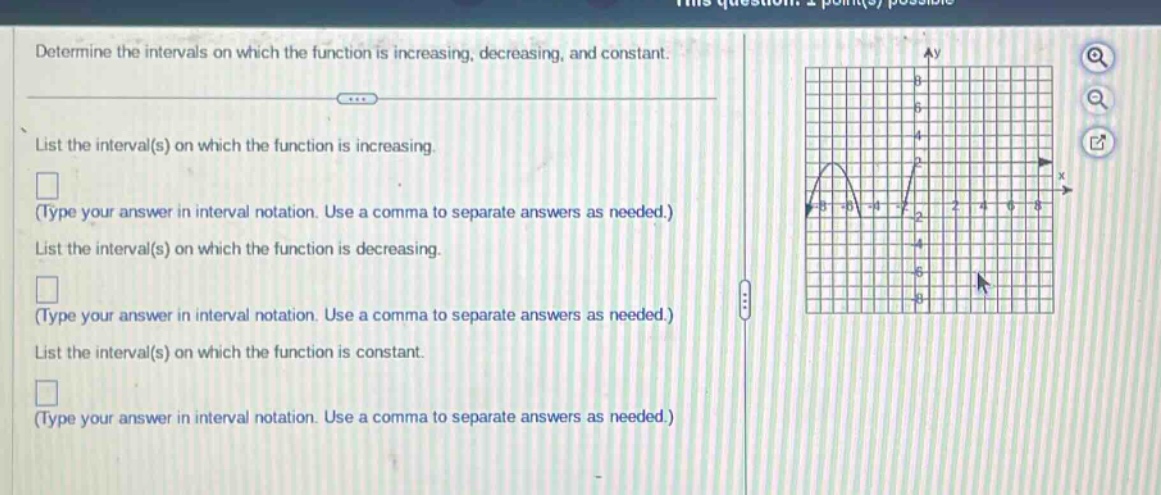
Observe where the graph goes up as we move from left - to - right. The function is increasing on the interval $(-3, -1)$.
Step2: Analyze decreasing intervals
Observe where the graph goes down as we move from left - to - right. The function is decreasing on the intervals $(-5,-3)$ and $(-1,1)$.
Step3: Analyze constant intervals
Observe where the graph is a horizontal line. There are no constant intervals for this graph.
Answer:
Increasing: $(-3, -1)$ Decreasing: $(-5,-3),(-1,1)$ Constant: None