determine the intervals on which the function is increasing, decreasing, and constant. list the interval(s)…
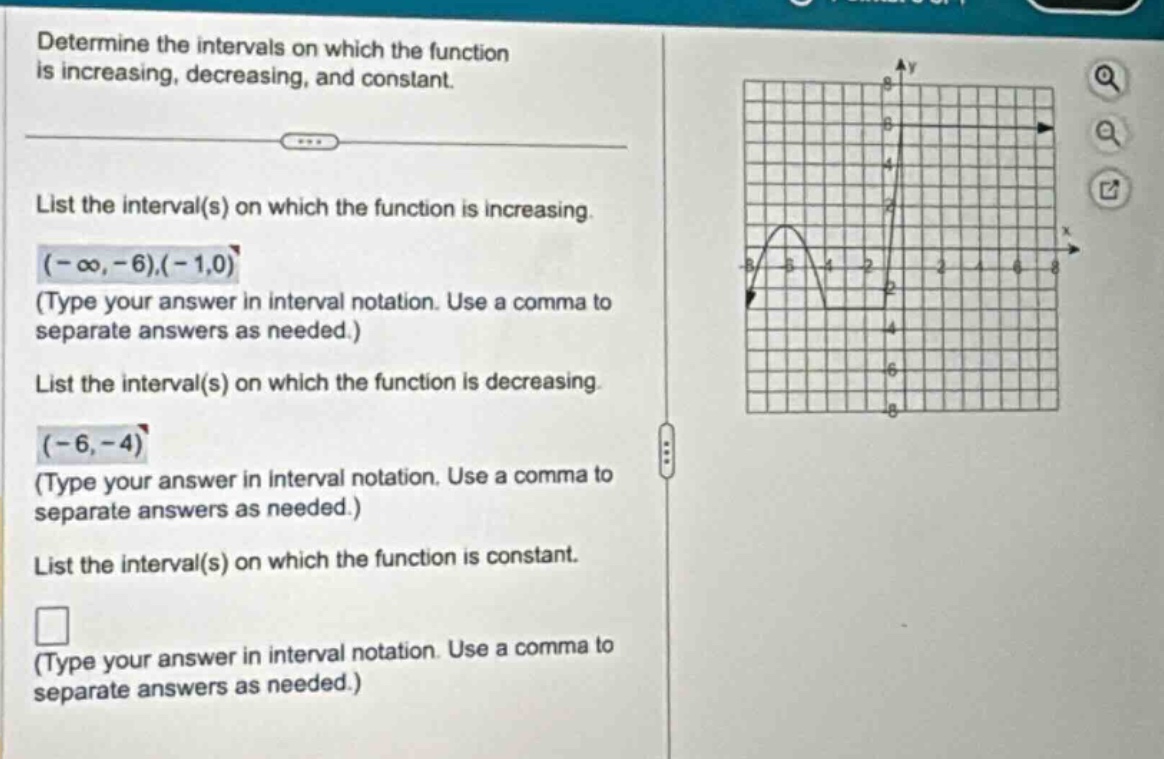
determine the intervals on which the function is increasing, decreasing, and constant. list the interval(s) on which the function is increasing. (-∞, -6),(-1,0) (type your answer in interval notation. use a comma to separate answers as needed.) list the interval(s) on which the function is decreasing (-6,-4) (type your answer in interval notation. use a comma to separate answers as needed.) list the interval(s) on which the function is constant. (type your answer in interval notation. use a comma to separate answers as needed.)
Answer
Explanation:
Step1: Understand increasing intervals
A function is increasing when the y - values increase as the x - values increase. By observing the graph, we can see that the function is going up on the intervals $(-\infty,-6)$ and $(-1,0)$.
Step2: Understand decreasing intervals
A function is decreasing when the y - values decrease as the x - values increase. From the graph, the function is going down on the interval $(-6,-4)$.
Step3: Determine constant intervals
A function is constant when the y - values do not change as the x - values change. By looking at the graph, there are no such intervals.
Answer:
Increasing intervals: $(-\infty,-6),(-1,0)$ Decreasing interval: $(-6,-4)$ Constant intervals: $\varnothing$