3. determine the intervals of increase and decrease for f(x)=x + 1/x 3 marks 4. if the sum of two positive…
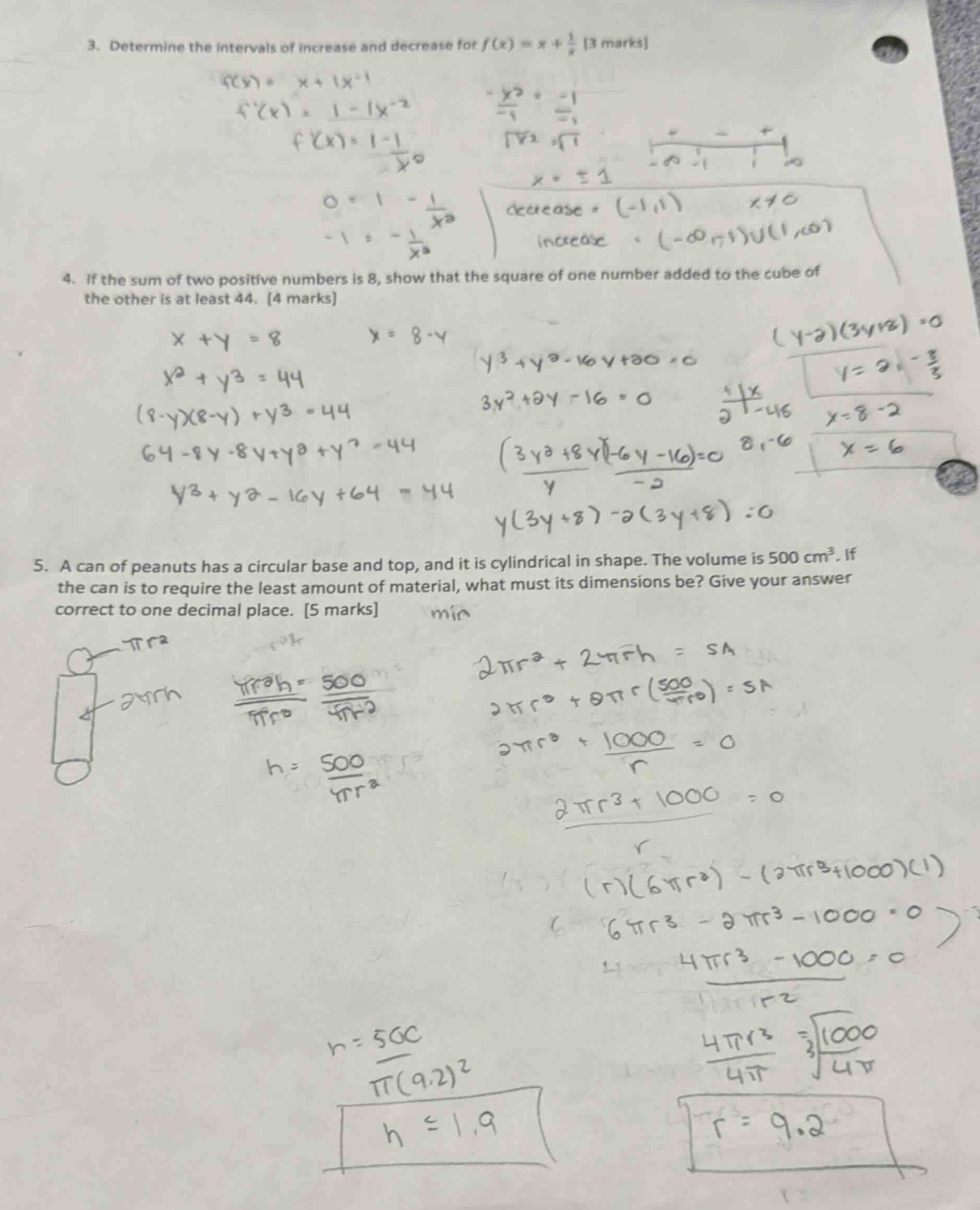
3. determine the intervals of increase and decrease for f(x)=x + 1/x 3 marks 4. if the sum of two positive numbers is 8, show that the square of one number added to the cube of the other is at least 44. 4 marks 5. a can of peanuts has a circular base and top, and it is cylindrical in shape. the volume is 500 cm³. if the can is to require the least amount of material, what must its dimensions be? give your answer correct to one decimal place. 5 marks
Answer
Explanation:
Step1: Find the derivative of (f(x)=x + \frac{1}{x})
Rewrite (f(x)) as (f(x)=x+x^{-1}). Using the power - rule ((x^n)^\prime=nx^{n - 1}), we have (f^\prime(x)=1 - x^{-2}=1-\frac{1}{x^{2}}=\frac{x^{2}-1}{x^{2}}=\frac{(x - 1)(x + 1)}{x^{2}}), with (x\neq0).
Step2: Find the critical points
Set (f^\prime(x)=0), so (\frac{(x - 1)(x + 1)}{x^{2}}=0). The numerator ((x - 1)(x + 1)=0) gives (x=-1) or (x = 1).
Step3: Determine the sign of (f^\prime(x)) in different intervals
- For (x\in(-\infty,-1)), let (x=-2). Then (f^\prime(-2)=\frac{(-2 - 1)(-2 + 1)}{(-2)^{2}}=\frac{(-3)\times(-1)}{4}=\frac{3}{4}>0), so (f(x)) is increasing on ((-\infty,-1)).
- For (x\in(-1,0)), let (x =-\frac{1}{2}). Then (f^\prime(-\frac{1}{2})=\frac{(-\frac{1}{2}-1)(-\frac{1}{2}+1)}{(-\frac{1}{2})^{2}}=\frac{(-\frac{3}{2})\times\frac{1}{2}}{\frac{1}{4}}=- 3<0), so (f(x)) is decreasing on ((-1,0)).
- For (x\in(0,1)), let (x=\frac{1}{2}). Then (f^\prime(\frac{1}{2})=\frac{(\frac{1}{2}-1)(\frac{1}{2}+1)}{(\frac{1}{2})^{2}}=\frac{(-\frac{1}{2})\times\frac{3}{2}}{\frac{1}{4}}=-3<0), so (f(x)) is decreasing on ((0,1)).
- For (x\in(1,\infty)), let (x = 2). Then (f^\prime(2)=\frac{(2 - 1)(2 + 1)}{2^{2}}=\frac{3}{4}>0), so (f(x)) is increasing on ((1,\infty)).
Answer:
The function (f(x)=x+\frac{1}{x}) is increasing on ((-\infty,-1)\cup(1,\infty)) and decreasing on ((-1,0)\cup(0,1)).
Explanation for the second problem:
Step1: Express one variable in terms of the other
Let the two positive numbers be (x) and (y). Given (x + y=8), then (x = 8 - y).
Step2: Set up the function
We want to minimize or analyze the function (g(y)=x^{2}+y^{3}=(8 - y)^{2}+y^{3}=64-16y + y^{2}+y^{3}).
Step3: Find the derivative
(g^\prime(y)=3y^{2}+2y-16).
Step4: Find the critical points
Set (g^\prime(y)=0), so (3y^{2}+2y - 16=(y - 2)(3y + 8)=0). Since (y>0), (y = 2). Then (x=8 - 2=6).
Step5: Evaluate the function
(g(2)=6^{2}+2^{3}=36 + 8=44). So the square of one number added to the cube of the other is at least 44.
Answer:
The proof is shown above.
Explanation for the third problem:
Step1: Recall the volume and surface - area formulas
The volume of a cylinder (V=\pi r^{2}h), and given (V = 500), so (h=\frac{500}{\pi r^{2}}). The surface area of a closed - top cylinder (SA = 2\pi r^{2}+2\pi rh).
Step2: Substitute (h) into the surface - area formula
(SA=2\pi r^{2}+2\pi r\times\frac{500}{\pi r^{2}}=2\pi r^{2}+\frac{1000}{r}).
Step3: Find the derivative of the surface - area function
(SA^\prime(r)=4\pi r-\frac{1000}{r^{2}}).
Step4: Set the derivative equal to zero to find critical points
(4\pi r-\frac{1000}{r^{2}} = 0). Multiply through by (r^{2}) to get (4\pi r^{3}-1000 = 0), then (r^{3}=\frac{1000}{4\pi}), and (r=\sqrt[3]{\frac{1000}{4\pi}}\approx5.4).
Step5: Find the value of (h)
(h=\frac{500}{\pi r^{2}}), substituting (r\approx5.4) gives (h=\frac{500}{\pi\times(5.4)^{2}}\approx5.4).
Answer:
The radius (r\approx5.4) cm and the height (h\approx5.4) cm.