determine the location and value of the absolute extreme values of f on the given interval, if they exist…
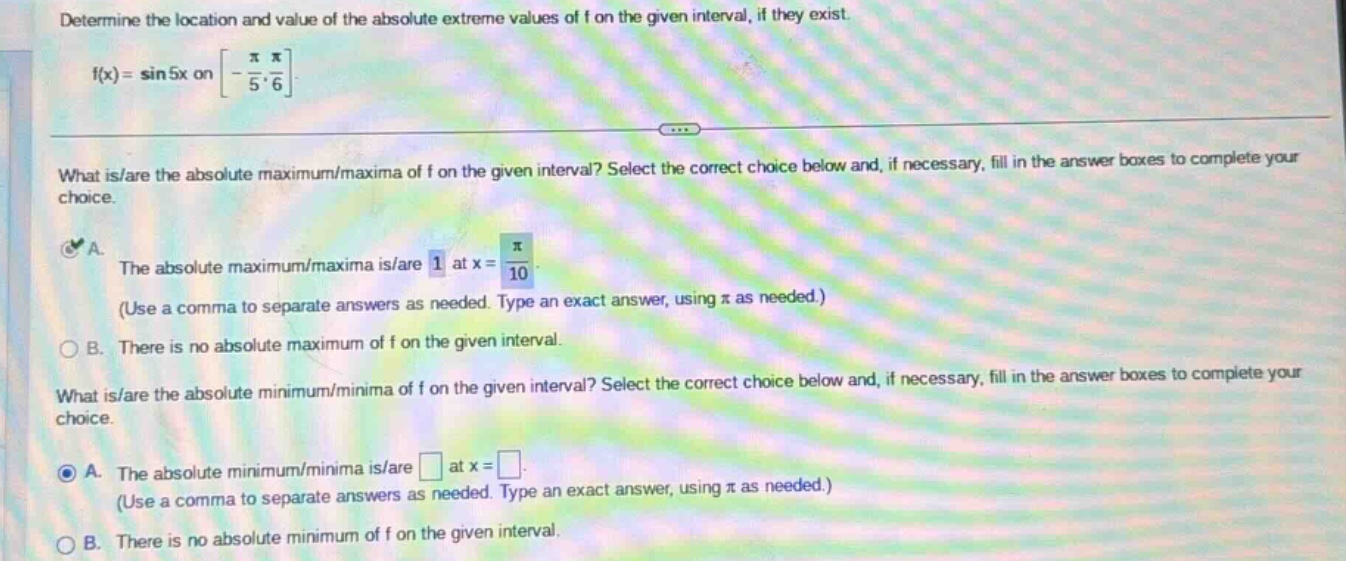
determine the location and value of the absolute extreme values of f on the given interval, if they exist. f(x)=sin5x on -π/5, π/6. what is/are the absolute maximum/maxima of f on the given interval? select the correct choice below and, if necessary, fill in the answer boxes to complete your choice. a. the absolute maximum/maxima is/are 1 at x = π/10. (use a comma to separate answers as needed. type an exact answer, using π as needed.) b. there is no absolute maximum of f on the given interval. what is/are the absolute minimum/minima of f on the given interval? select the correct choice below and, if necessary, fill in the answer boxes to complete your choice. a. the absolute minimum/minima is/are at x = . (use a comma to separate answers as needed. type an exact answer, using π as needed.) b. there is no absolute minimum of f on the given interval.
Answer
Explanation:
Step1: Find the derivative
The derivative of $y = \sin(5x)$ using the chain - rule. If $y=\sin(u)$ and $u = 5x$, then $\frac{dy}{du}=\cos(u)$ and $\frac{du}{dx}=5$. So, $f^\prime(x)=5\cos(5x)$.
Step2: Find critical points
Set $f^\prime(x) = 0$, so $5\cos(5x)=0$. Then $\cos(5x)=0$. We know that $\cos\theta = 0$ when $\theta=\frac{\pi}{2}+k\pi,k\in\mathbb{Z}$. So, $5x=\frac{\pi}{2}+k\pi$, and $x=\frac{\pi}{10}+\frac{k\pi}{5}$. We need to find the values of $x$ that lie in the interval $[-\frac{\pi}{5},\frac{\pi}{6}]$. When $k = 0$, $x=\frac{\pi}{10}$; when $k=-1$, $x=\frac{\pi}{10}-\frac{\pi}{5}=-\frac{\pi}{10}$.
Step3: Evaluate the function at critical points and endpoints
Evaluate $f(x)=\sin(5x)$ at $x = -\frac{\pi}{5},-\frac{\pi}{10},\frac{\pi}{10},\frac{\pi}{6}$.
- $f(-\frac{\pi}{5})=\sin(-\pi)=0$.
- $f(-\frac{\pi}{10})=\sin(-\frac{\pi}{2})=- 1$.
- $f(\frac{\pi}{10})=\sin(\frac{\pi}{2}) = 1$.
- $f(\frac{\pi}{6})=\sin(\frac{5\pi}{6})=\frac{1}{2}$.
Answer:
The absolute minimum is $-1$ at $x =-\frac{\pi}{10}$. So the answer for the absolute - minimum part is A. The absolute minimum/minima is/are $-1$ at $x =-\frac{\pi}{10}$.