determine the location and value of the absolute extreme values of f on the given interval, if they exist…
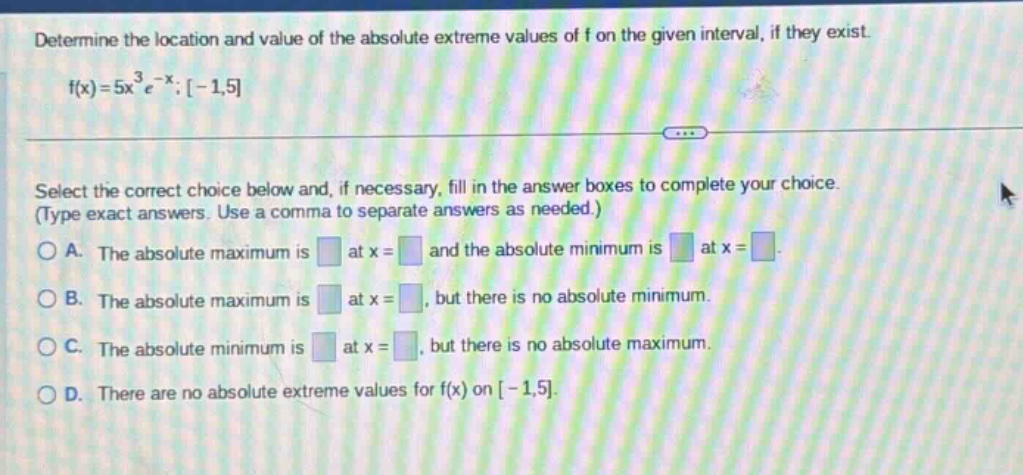
determine the location and value of the absolute extreme values of f on the given interval, if they exist. f(x)=5x³e⁻ˣ;-1,5 select the correct choice below and, if necessary, fill in the answer boxes to complete your choice. (type exact answers. use a comma to separate answers as needed.) a. the absolute maximum is at x = and the absolute minimum is at x = b. the absolute maximum is at x =, but there is no absolute minimum. c. the absolute minimum is at x =, but there is no absolute maximum. d. there are no absolute extreme values for f(x) on -1,5.
Answer
Explanation:
Step1: Find the derivative of (f(x))
Using the product - rule ((uv)^\prime = u^\prime v+uv^\prime), where (u = 5x^{3}) and (v=e^{-x}). (u^\prime=15x^{2}) and (v^\prime=-e^{-x}). So (f^\prime(x)=15x^{2}e^{-x}-5x^{3}e^{-x}=5x^{2}e^{-x}(3 - x)).
Step2: Find the critical points
Set (f^\prime(x) = 0). Since (5x^{2}e^{-x}(3 - x)=0), and (e^{-x}>0) for all (x), then (5x^{2}(3 - x)=0). Solving (5x^{2}(3 - x)=0) gives (x = 0) and (x = 3). Both (x = 0) and (x = 3) are in the domain of (f(x)). And (x = 0\in[-1,5]), (x = 3\in[-1,5]).
Step3: Evaluate (f(x)) at critical points and endpoints
Evaluate (f(x)=5x^{3}e^{-x}) at (x=-1), (x = 0), (x = 3) and (x = 5). When (x=-1), (f(-1)=5\times(-1)^{3}\times e^{1}=-5e\approx - 13.59). When (x = 0), (f(0)=5\times0^{3}\times e^{0}=0). When (x = 3), (f(3)=5\times3^{3}\times e^{-3}=5\times27\times\frac{1}{e^{3}}=\frac{135}{e^{3}}\approx6.68). When (x = 5), (f(5)=5\times5^{3}\times e^{-5}=5^{4}\times\frac{1}{e^{5}}=\frac{625}{e^{5}}\approx4.18).
Answer:
A. The absolute maximum is (\frac{135}{e^{3}}) at (x = 3) and the absolute minimum is (-5e) at (x=-1)