determine the location and value of the absolute extreme values of f on the given interval, if they exist…
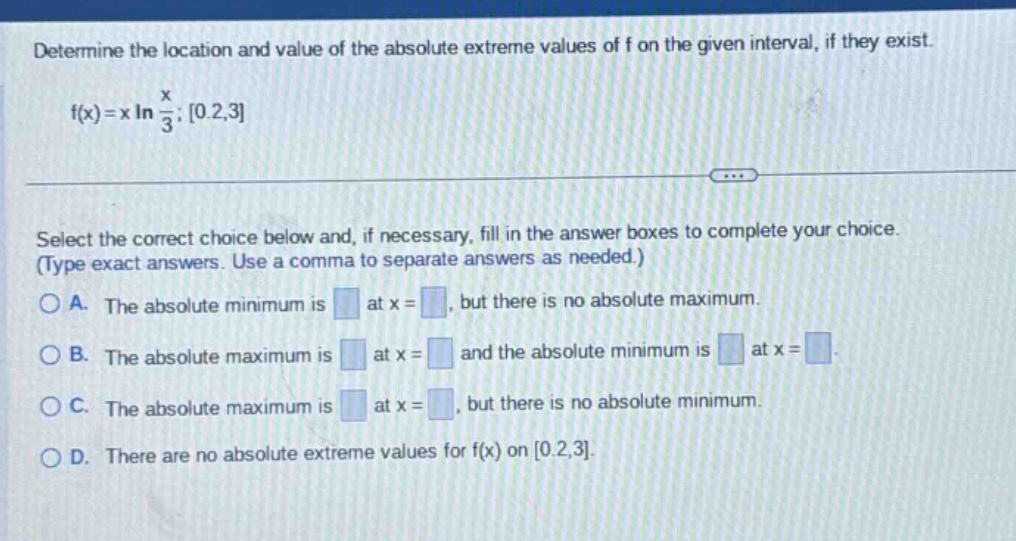
determine the location and value of the absolute extreme values of f on the given interval, if they exist. f(x)=x ln(x/3); 0.2,3 select the correct choice below and, if necessary, fill in the answer boxes to complete your choice. (type exact answers. use a comma to separate answers as needed.) a. the absolute minimum is at x =, but there is no absolute maximum. b. the absolute maximum is at x = and the absolute minimum is at x =. c. the absolute maximum is at x =, but there is no absolute minimum. d. there are no absolute extreme values for f(x) on 0.2,3.
Answer
Explanation:
Step1: Find the derivative
First, use the product - rule $(uv)^\prime = u^\prime v+uv^\prime$, where $u = x$ and $v=\ln\frac{x}{3}$. The derivative of $u=x$ is $u^\prime = 1$, and the derivative of $v=\ln\frac{x}{3}=\ln x-\ln3$ is $v^\prime=\frac{1}{x}$. So, $f^\prime(x)=\ln\frac{x}{3}+x\cdot\frac{1}{x}=\ln\frac{x}{3} + 1$.
Step2: Find the critical points
Set $f^\prime(x)=0$. Then $\ln\frac{x}{3}+1 = 0$. Subtract 1 from both sides: $\ln\frac{x}{3}=-1$. By the definition of the natural logarithm, $\frac{x}{3}=e^{-1}$, so $x = \frac{3}{e}\approx1.104$.
Step3: Evaluate the function at critical and endpoints
Evaluate $f(x)$ at $x = 0.2$, $x=\frac{3}{e}$, and $x = 3$.
- $f(0.2)=0.2\ln\frac{0.2}{3}=0.2(\ln0.2-\ln3)\approx0.2(- 1.609 - 1.099)=0.2\times(-2.708)=-0.5416$.
- $f(\frac{3}{e})=\frac{3}{e}\ln\frac{\frac{3}{e}}{3}=\frac{3}{e}\ln\frac{1}{e}=\frac{3}{e}\times(-1)=-\frac{3}{e}\approx - 1.104$.
- $f(3)=3\ln\frac{3}{3}=3\ln1 = 0$.
Answer:
B. The absolute maximum is $0$ at $x = 3$ and the absolute minimum is $-\frac{3}{e}$ at $x=\frac{3}{e}$