determine the period of the function. also use the language of transformations to describe how the function…
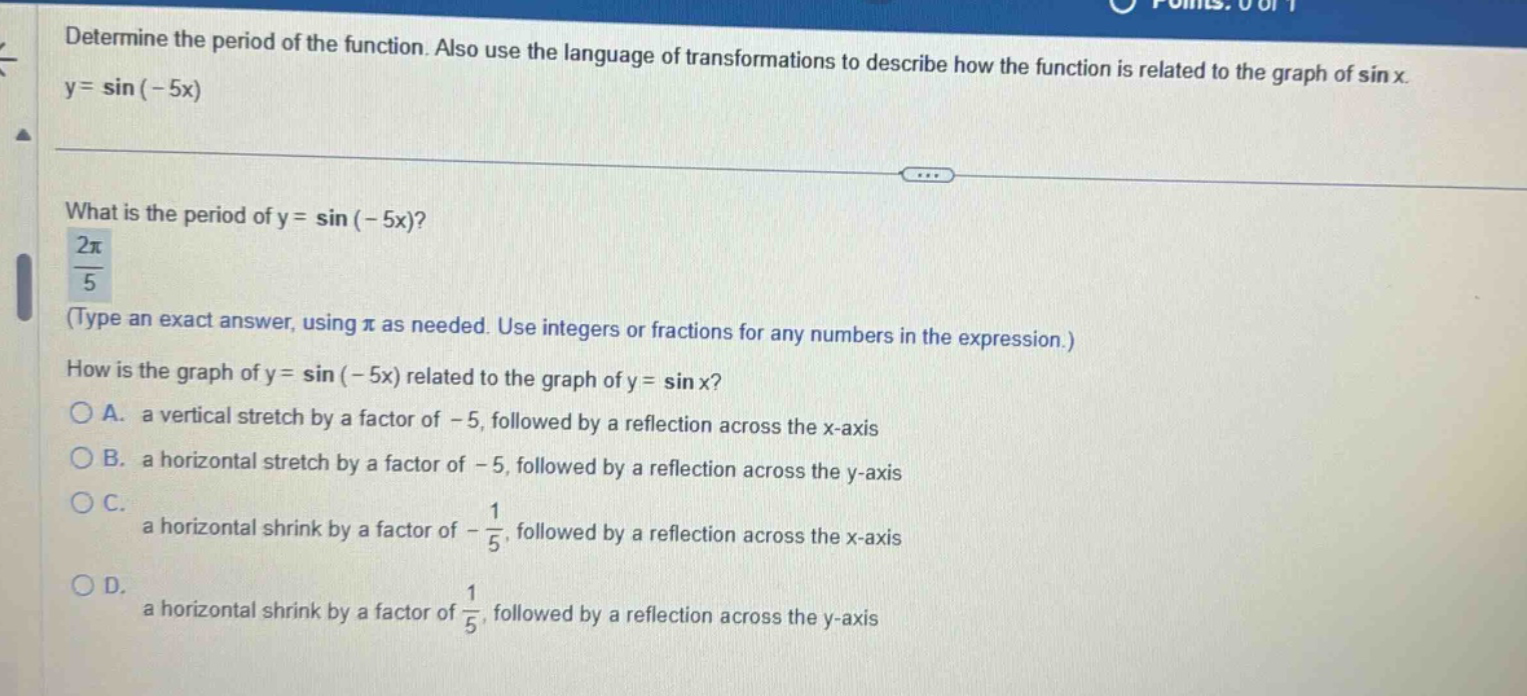
determine the period of the function. also use the language of transformations to describe how the function is related to the graph of sin x. y = sin(-5x) what is the period of y = sin(-5x)? 2π/5 (type an exact answer, using π as needed. use integers or fractions for any numbers in the expression.) how is the graph of y = sin(-5x) related to the graph of y = sin x? a. a vertical stretch by a factor of -5, followed by a reflection across the x - axis b. a horizontal stretch by a factor of -5, followed by a reflection across the y - axis c. a horizontal shrink by a factor of -1/5, followed by a reflection across the x - axis d. a horizontal shrink by a factor of 1/5, followed by a reflection across the y - axis
Answer
Explanation:
Step1: Recall period - formula for sine function
The period of the function $y = A\sin(Bx - C)+D$ is given by $T=\frac{2\pi}{|B|}$. For the function $y=\sin(- 5x)$, where $B=-5$, then $T = \frac{2\pi}{|-5|}=\frac{2\pi}{5}$.
Step2: Analyze graph - transformations
For the function $y = \sin(x)$ to $y=\sin(-5x)$, first consider the horizontal - scale change. The general form of a horizontal scale change from $y = f(x)$ to $y = f(bx)$ is a horizontal shrink by a factor of $\frac{1}{|b|}$ when $|b|>1$ and a horizontal stretch by a factor of $\frac{1}{|b|}$ when $|b|<1$. Here $b = - 5$, so there is a horizontal shrink by a factor of $\frac{1}{5}$. The negative sign in front of $5x$ means a reflection across the $y$ - axis.
Answer:
The period is $\frac{2\pi}{5}$. D. a horizontal shrink by a factor of $\frac{1}{5}$, followed by a reflection across the $y$-axis