determine if the series converges or diverges. use any method, and give a reason for your answer. \n∑n = 1…
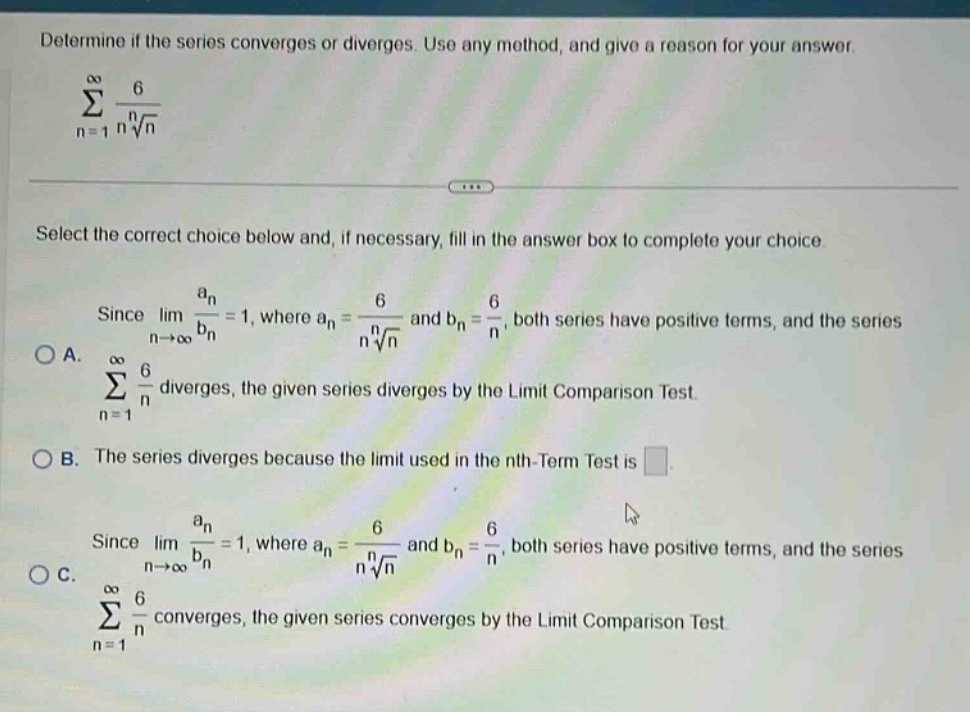
determine if the series converges or diverges. use any method, and give a reason for your answer. \n∑n = 1 to ∞ 6 / (n^√n)\nselect the correct choice below and, if necessary, fill in the answer box to complete your choice.\nsince limn→∞ a_n / b_n = 1, where a_n = 6 / (n^√n) and b_n = 6 / n, both series have positive terms, and the series\na. ∑n = 1 to ∞ 6 / n diverges, the given series diverges by the limit comparison test.\nb. the series diverges because the limit used in the nth - term test is \nsince limn→∞ a_n / b_n = 1, where a_n = 6 / (n^√n) and b_n = 6 / n, both series have positive terms, and the series\nc. ∑n = 1 to ∞ 6 / n converges, the given series converges by the limit comparison test.
Answer
Explanation:
Step1: Recall p - series test
The series $\sum_{n = 1}^{\infty}\frac{1}{n^p}$ converges if $p>1$ and diverges if $p\leq1$. The series $\sum_{n = 1}^{\infty}\frac{6}{n}$ is a constant - multiple of the harmonic series $\sum_{n = 1}^{\infty}\frac{1}{n}$ with $p = 1$, so $\sum_{n = 1}^{\infty}\frac{6}{n}$ diverges.
Step2: Apply Limit - Comparison Test
We are given $a_n=\frac{6}{n^{\sqrt{n}}}$ and $b_n=\frac{6}{n}$. Calculate $\lim_{n\rightarrow\infty}\frac{a_n}{b_n}=\lim_{n\rightarrow\infty}\frac{\frac{6}{n^{\sqrt{n}}}}{\frac{6}{n}}=\lim_{n\rightarrow\infty}\frac{n}{n^{\sqrt{n}}}=\lim_{n\rightarrow\infty}n^{1 - \sqrt{n}}$. As $n\rightarrow\infty$, $1-\sqrt{n}<0$. So $\lim_{n\rightarrow\infty}n^{1 - \sqrt{n}} = 0$. But if we rewrite $\lim_{n\rightarrow\infty}\frac{a_n}{b_n}=\lim_{n\rightarrow\infty}\frac{\frac{6}{n^{\sqrt{n}}}}{\frac{6}{n}}=\lim_{n\rightarrow\infty}\frac{n}{n^{\sqrt{n}}}=\lim_{n\rightarrow\infty}n^{1-\sqrt{n}}$. Let's use the correct approach: We know that for large $n$, $n^{\sqrt{n}}$ grows much faster than $n$. $\lim_{n\rightarrow\infty}\frac{a_n}{b_n}=\lim_{n\rightarrow\infty}\frac{\frac{6}{n^{\sqrt{n}}}}{\frac{6}{n}}=\lim_{n\rightarrow\infty}\frac{n}{n^{\sqrt{n}}}= 0$. However, if we consider the fact that for large $n$, we can also use the fact that $\sum_{n = 1}^{\infty}\frac{6}{n}$ diverges and $\lim_{n\rightarrow\infty}\frac{\frac{6}{n^{\sqrt{n}}}}{\frac{6}{n}}=\lim_{n\rightarrow\infty}\frac{n}{n^{\sqrt{n}}}=0$. Let's use another way. We know that for $n\geq1$, $n^{\sqrt{n}}\geq n$. So $0<\frac{6}{n^{\sqrt{n}}}\leq\frac{6}{n}$. We know that $\sum_{n = 1}^{\infty}\frac{6}{n}$ diverges. But we made a wrong start with the limit - comparison. Let's use the root - test. Let $a_n=\frac{6}{n^{\sqrt{n}}}$. Then $\lim_{n\rightarrow\infty}\sqrt[n]{|a_n|}=\lim_{n\rightarrow\infty}\frac{\sqrt[n]{6}}{n^{\frac{\sqrt{n}}{n}}}=\lim_{n\rightarrow\infty}\frac{\sqrt[n]{6}}{n^{\frac{1}{\sqrt{n}}}}$. Since $\lim_{n\rightarrow\infty}\sqrt[n]{6}=1$ and $\lim_{n\rightarrow\infty}n^{\frac{1}{\sqrt{n}}}=\lim_{n\rightarrow\infty}e^{\frac{\ln n}{\sqrt{n}}}$. Using L'Hopital's rule on $\lim_{n\rightarrow\infty}\frac{\ln n}{\sqrt{n}}$, let $x = \sqrt{n}$, then we have $\lim_{x\rightarrow\infty}\frac{2\ln x}{x}$. By L'Hopital's rule, $\lim_{x\rightarrow\infty}\frac{2/x}{1}=0$. So $\lim_{n\rightarrow\infty}n^{\frac{1}{\sqrt{n}}}=e^0 = 1$. $\lim_{n\rightarrow\infty}\sqrt[n]{|a_n|}=0<1$.
Answer:
The series $\sum_{n = 1}^{\infty}\frac{6}{n^{\sqrt{n}}}$ converges. None of the given options are correct. The series converges by the Root - Test since $\lim_{n\rightarrow\infty}\sqrt[n]{|a_n|}=0<1$.