determine the values of x on which the function $f(x)=\frac{2x^{2}-x - 15}{4x^{2}-12x}$ is discontinuous and…
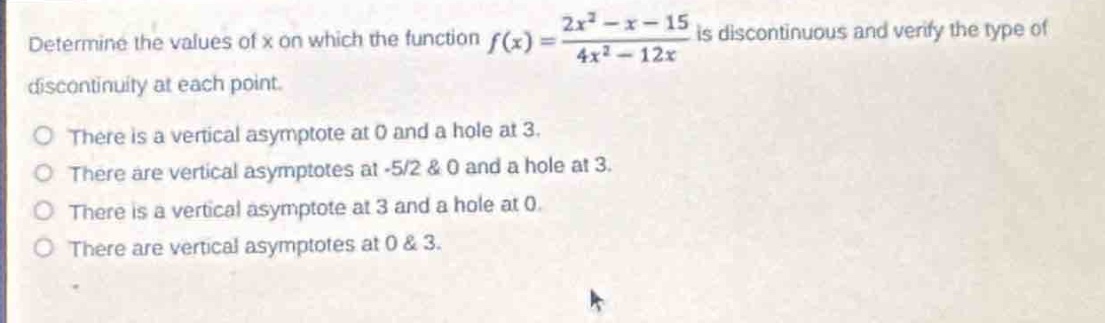
determine the values of x on which the function $f(x)=\frac{2x^{2}-x - 15}{4x^{2}-12x}$ is discontinuous and verify the type of discontinuity at each point.\nthere is a vertical asymptote at 0 and a hole at 3.\nthere are vertical asymptotes at -5/2 & 0 and a hole at 3.\nthere is a vertical asymptote at 3 and a hole at 0.\nthere are vertical asymptotes at 0 & 3.
Answer
Explanation:
Step1: Factor the numerator and denominator
The numerator (2x^{2}-x - 15=2x^{2}-6x + 5x-15=2x(x - 3)+5(x - 3)=(2x + 5)(x - 3)). The denominator (4x^{2}-12x=4x(x - 3)). So (f(x)=\frac{(2x + 5)(x - 3)}{4x(x - 3)}).
Step2: Find the values of (x) that make the denominator zero
Set (4x(x - 3)=0). Solving (4x(x - 3)=0) gives (x = 0) and (x=3) as the values where the function is potentially discontinuous.
Step3: Simplify the function
Cancel out the common factor ((x - 3)) (for (x\neq3)), we get (y=\frac{2x + 5}{4x}=\frac{1}{2}+\frac{5}{4x}) for (x\neq3).
Step4: Analyze the type of discontinuity at (x = 0)
As (x\to0), (\lim_{x\to0}\frac{2x + 5}{4x}=\pm\infty) (the sign depends on the side - approach), so there is a vertical asymptote at (x = 0).
Step5: Analyze the type of discontinuity at (x = 3)
(\lim_{x\to3}\frac{(2x + 5)(x - 3)}{4x(x - 3)}=\lim_{x\to3}\frac{2x+5}{4x}=\frac{2\times3 + 5}{4\times3}=\frac{6 + 5}{12}=\frac{11}{12}), but the function is not defined at (x = 3) originally, so there is a hole at (x = 3).
Answer:
There is a vertical asymptote at 0 and a hole at 3.