determine the vertical asymptotes of the graph of the function. give your answers as equations in exact…
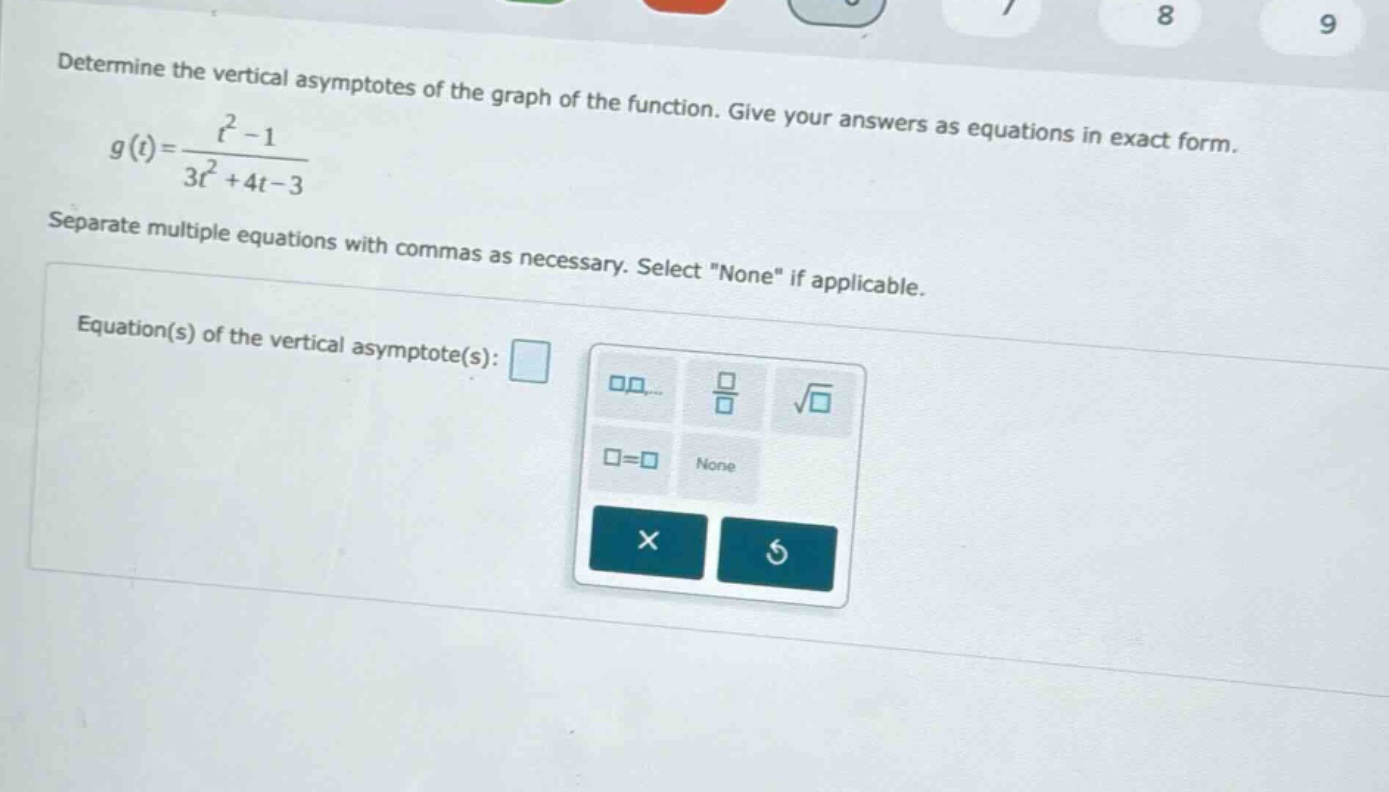
determine the vertical asymptotes of the graph of the function. give your answers as equations in exact form. g(t)=(t² - 1)/(3t² + 4t - 3) separate multiple equations with commas as necessary. select \none\ if applicable. equation(s) of the vertical asymptote(s):
Answer
Explanation:
Step1: Find when denominator is 0
Set $3t^{2}+4t - 3=0$.
Step2: Use quadratic formula
For $at^{2}+bt + c = 0$ ($a = 3$, $b = 4$, $c=-3$), $t=\frac{-b\pm\sqrt{b^{2}-4ac}}{2a}$. So $t=\frac{-4\pm\sqrt{4^{2}-4\times3\times(-3)}}{2\times3}=\frac{-4\pm\sqrt{16 + 36}}{6}=\frac{-4\pm\sqrt{52}}{6}=\frac{-4\pm2\sqrt{13}}{6}=\frac{-2\pm\sqrt{13}}{3}$.
Answer:
$t=\frac{-2+\sqrt{13}}{3},t=\frac{-2 - \sqrt{13}}{3}$