determine whether the following integral converges or diverges.\n∫0,∞ dx/(e^x + 3)\nas x approaches ∞, which…
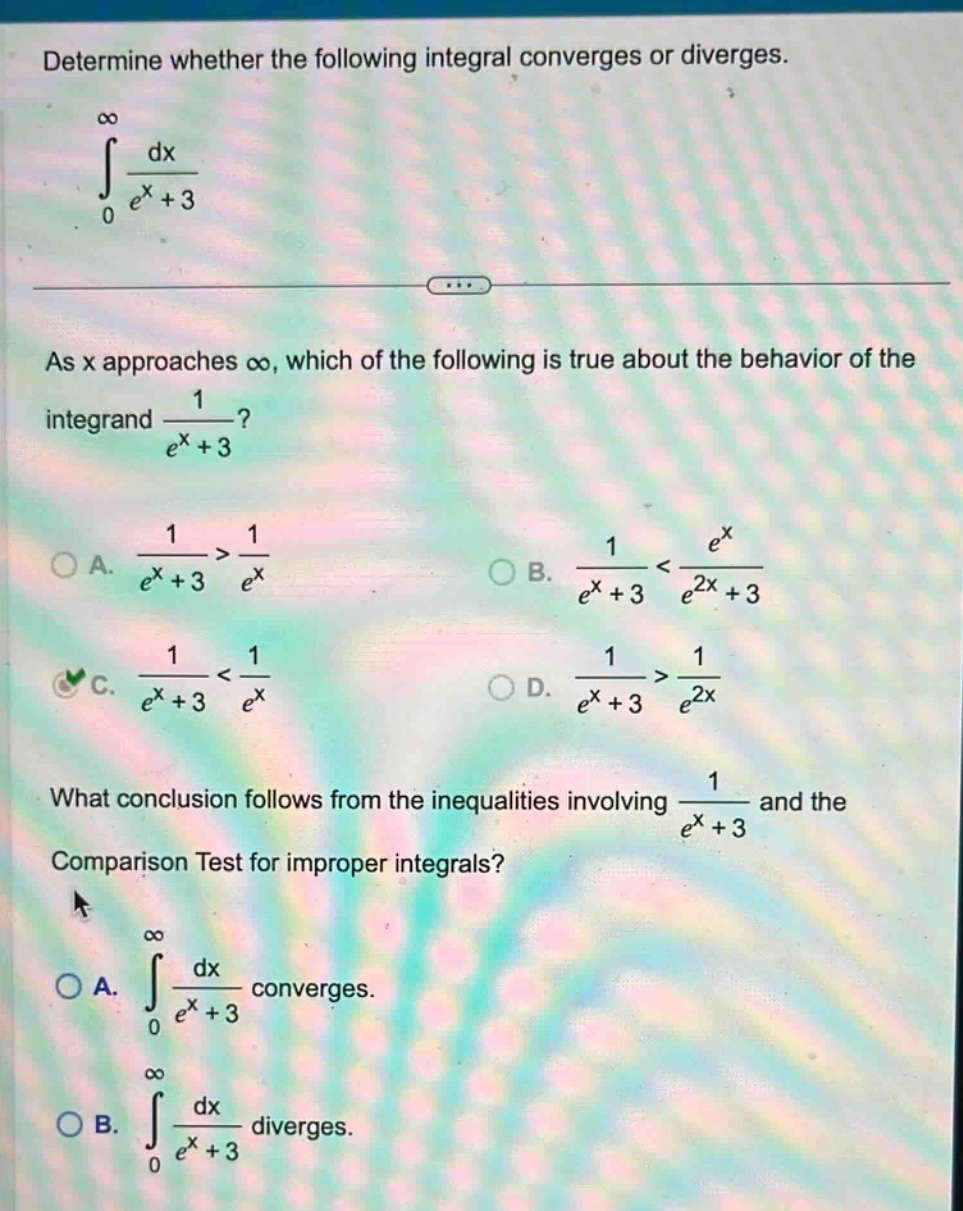
determine whether the following integral converges or diverges.\n∫0,∞ dx/(e^x + 3)\nas x approaches ∞, which of the following is true about the behavior of the integrand 1/(e^x + 3)?\na. 1/(e^x + 3) > 1/e^x\nb. 1/(e^x + 3) < e^x/(e^2x + 3)\nc. 1/(e^x + 3) < 1/e^x\nd. 1/(e^x + 3) > 1/e^2x\nwhat conclusion follows from the inequalities involving 1/(e^x + 3) and the comparison test for improper integrals?\na. ∫0,∞ dx/(e^x + 3) converges.\nb. ∫0,∞ dx/(e^x + 3) diverges.
Answer
Explanation:
Step1: Analyze the integrand behavior
For positive - valued functions, when comparing $\frac{1}{e^{x}+3}$ and $\frac{1}{e^{x}}$, since $e^{x}+3>e^{x}$ for all $x\geq0$, then $\frac{1}{e^{x}+3}<\frac{1}{e^{x}}$.
Step2: Recall the convergence of $\int_{0}^{\infty}\frac{1}{e^{x}}dx$
We know that $\int_{0}^{\infty}\frac{1}{e^{x}}dx=\int_{0}^{\infty}e^{-x}dx$. Using the integral formula $\int e^{-x}dx=-e^{-x}+C$. Then $\lim_{b\rightarrow\infty}\int_{0}^{b}e^{-x}dx=\lim_{b\rightarrow\infty}(-e^{-b}+e^{0}) = 1$, so $\int_{0}^{\infty}\frac{1}{e^{x}}dx$ converges.
Step3: Apply the Comparison Test for improper integrals
The Comparison Test states that if $0\leq f(x)\leq g(x)$ for all $x\geq a$ and $\int_{a}^{\infty}g(x)dx$ converges, then $\int_{a}^{\infty}f(x)dx$ converges. Here, $f(x)=\frac{1}{e^{x}+3}$, $g(x)=\frac{1}{e^{x}}$, $a = 0$. Since $\int_{0}^{\infty}\frac{1}{e^{x}}dx$ converges and $\frac{1}{e^{x}+3}<\frac{1}{e^{x}}$ for $x\geq0$, $\int_{0}^{\infty}\frac{1}{e^{x}+3}dx$ converges.
Answer:
- For the first - part question: C. $\frac{1}{e^{x}+3}<\frac{1}{e^{x}}$
- For the second - part question: A. $\int_{0}^{\infty}\frac{dx}{e^{x}+3}$ converges.