determine whether the following integral converges or diverges.\n∫(0 to 2) 1/√(1/x^5 + x) dx\nas x…
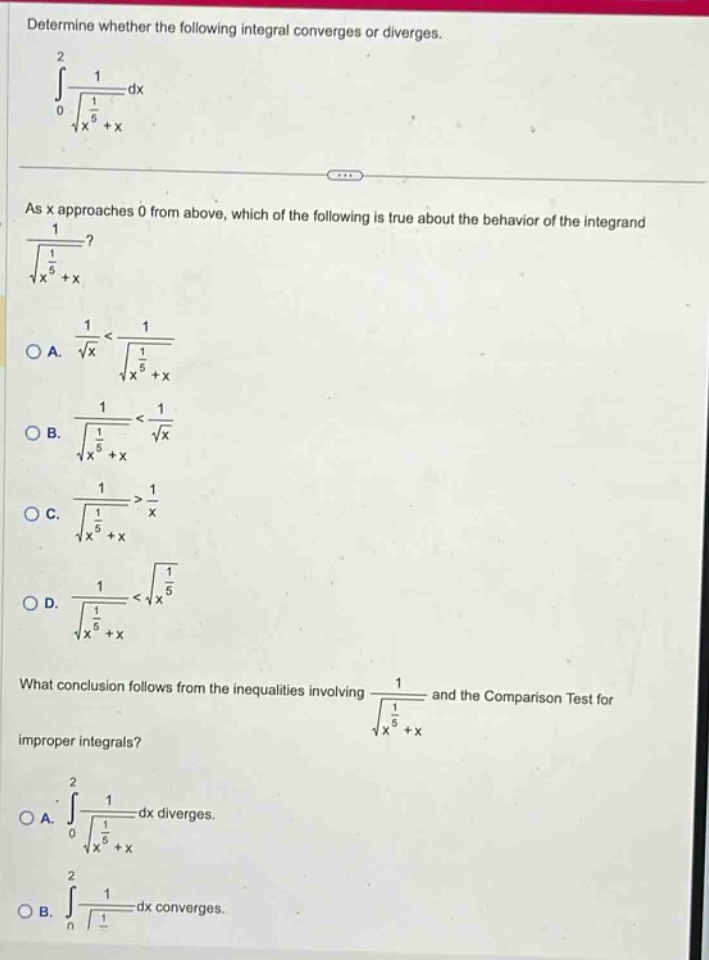
determine whether the following integral converges or diverges.\n∫(0 to 2) 1/√(1/x^5 + x) dx\nas x approaches 0 from above, which of the following is true about the behavior of the integrand 1/√(1/x^5 + x)?\na. 1/√x < 1/√(1/x^5 + x)\nb. 1/√(1/x^5 + x) < 1/√x\nc. 1/√(1/x^5 + x) > 1/x\nd. 1/√(1/x^5 + x) < √(1/x^5)\nwhat conclusion follows from the inequalities involving 1/√(1/x^5 + x) and the comparison test for improper integrals?\na. ∫(0 to 2) 1/√(1/x^5 + x) dx diverges.\nb. ∫(0 to 2) 1/√(1/x^5 + x) dx converges.
Answer
Explanation:
Step1: Analyze the integrand near x = 0
As (x\to0^{+}), we have (\frac{1}{x^{5}}+x\approx\frac{1}{x^{5}}) (since (\frac{1}{x^{5}}) dominates (x) as (x\to0^{+})). So, (\sqrt{\frac{1}{x^{5}} + x}\approx\sqrt{\frac{1}{x^{5}}}=\frac{1}{x^{\frac{5}{2}}}), and the integrand (\frac{1}{\sqrt{\frac{1}{x^{5}}+x}}\approx x^{\frac{5}{2}}). Also, we know that for (x> 0), (\frac{1}{x^{5}}+x>\frac{1}{x^{5}}), then (\sqrt{\frac{1}{x^{5}}+x}>\frac{1}{x^{\frac{5}{2}}}), and (\frac{1}{\sqrt{\frac{1}{x^{5}}+x}}<x^{\frac{5}{2}}). Another way is to consider the following: We know that for (x>0), (\frac{1}{x^{5}}+x > \frac{1}{x}) when (x) is small. Taking square - roots, (\sqrt{\frac{1}{x^{5}}+x}>\frac{1}{\sqrt{x}}), so (\frac{1}{\sqrt{\frac{1}{x^{5}}+x}}<\frac{1}{\frac{1}{\sqrt{x}}}=\sqrt{x}).
Step2: Recall the p - integral test
The integral (\int_{0}^{a}\frac{1}{x^{p}}dx) converges if (p < 1) and diverges if (p\geq1) for (a>0). The integral (\int_{0}^{2}\frac{1}{\sqrt{\frac{1}{x^{5}}+x}}dx) has a potential singularity at (x = 0). Since (\frac{1}{\sqrt{\frac{1}{x^{5}}+x}}<\sqrt{x}=x^{\frac{1}{2}}) and (\int_{0}^{2}x^{\frac{1}{2}}dx=\left[\frac{2}{3}x^{\frac{3}{2}}\right]{0}^{2}=\frac{2}{3}\times2^{\frac{3}{2}}) converges (because (p=\frac{1}{2}<1) in the p - integral (\int{0}^{2}x^{p}dx)). By the comparison test for improper integrals, if (0\leq f(x)\leq g(x)) on ([0,2]) and (\int_{0}^{2}g(x)dx) converges, then (\int_{0}^{2}f(x)dx) converges.
For the first multiple - choice part: As (x\to0^{+}), (\frac{1}{x^{5}}+x) is large. We know that (\sqrt{\frac{1}{x^{5}}+x}>\frac{1}{\sqrt{x}}), so (\frac{1}{\sqrt{\frac{1}{x^{5}}+x}}<\sqrt{x}), and the correct inequality is (\frac{1}{\sqrt{\frac{1}{x^{5}}+x}}<\frac{1}{\frac{1}{\sqrt{x}}}), so the answer is B.
For the second multiple - choice part: Since (\frac{1}{\sqrt{\frac{1}{x^{5}}+x}}<\sqrt{x}) and (\int_{0}^{2}\sqrt{x}dx) converges, by the comparison test for improper integrals, (\int_{0}^{2}\frac{1}{\sqrt{\frac{1}{x^{5}}+x}}dx) converges. So the answer is B.
Answer:
For the first multiple - choice: B. (\frac{1}{\sqrt{\frac{1}{x^{5}}+x}}<\frac{1}{\sqrt{x}}) For the second multiple - choice: B. (\int_{0}^{2}\frac{1}{\sqrt{\frac{1}{x^{5}}+x}}dx) converges.