determine whether the following series converge absolutely, converge conditionally, or diverge.\n46. $sum_{k…
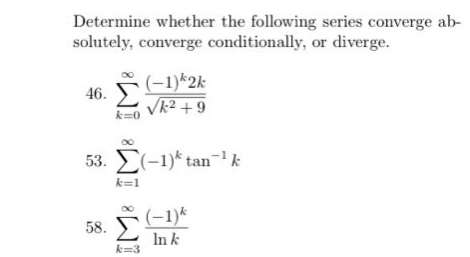
determine whether the following series converge absolutely, converge conditionally, or diverge.\n46. $sum_{k = 0}^{infty}\frac{(-1)^{k}2k}{sqrt{k^{2}+9}}$\n53. $sum_{k = 1}^{infty}(-1)^{k}\tan^{-1}k$\n58. $sum_{k = 3}^{infty}\frac{(-1)^{k}}{ln k}$
Answer
Explanation:
Step1: Recall absolute - convergence test
First, consider the absolute - value of the series. For a series $\sum_{k = 0}^{\infty}a_{k}$, we look at $\sum_{k = 0}^{\infty}|a_{k}|$.
Step2: Analyze $\sum_{k = 0}^{\infty}\left|\frac{(- 1)^{k}2k}{\sqrt{k^{2}+9}}\right|$
We have $\sum_{k = 0}^{\infty}\left|\frac{(-1)^{k}2k}{\sqrt{k^{2}+9}}\right|=\sum_{k = 0}^{\infty}\frac{2k}{\sqrt{k^{2}+9}}$. Using the limit comparison test with the series $\sum_{k = 0}^{\infty}2$. $\lim_{k\rightarrow\infty}\frac{\frac{2k}{\sqrt{k^{2}+9}}}{2}=\lim_{k\rightarrow\infty}\frac{k}{\sqrt{k^{2}+9}}=\lim_{k\rightarrow\infty}\frac{1}{\sqrt{1 + \frac{9}{k^{2}}}} = 1$. Since $\sum_{k = 0}^{\infty}2$ diverges, $\sum_{k = 0}^{\infty}\frac{2k}{\sqrt{k^{2}+9}}$ diverges. For the alternating - series test, let $a_{k}=\frac{2k}{\sqrt{k^{2}+9}}$. $\lim_{k\rightarrow\infty}a_{k}=\lim_{k\rightarrow\infty}\frac{2k}{\sqrt{k^{2}+9}} = 2\neq0$. So, the series $\sum_{k = 0}^{\infty}\frac{(-1)^{k}2k}{\sqrt{k^{2}+9}}$ diverges.
Step3: Analyze $\sum_{k = 1}^{\infty}\left|(-1)^{k}\tan^{- 1}k\right|$
We have $\sum_{k = 1}^{\infty}\left|(-1)^{k}\tan^{- 1}k\right|=\sum_{k = 1}^{\infty}\tan^{- 1}k$. Since $\lim_{k\rightarrow\infty}\tan^{- 1}k=\frac{\pi}{2}\neq0$, by the $n$ - th term test for divergence, $\sum_{k = 1}^{\infty}\tan^{- 1}k$ diverges. For the alternating - series test, let $a_{k}=\tan^{- 1}k$. The function $y = \tan^{- 1}x$ is an increasing function and $\lim_{k\rightarrow\infty}\tan^{- 1}k=\frac{\pi}{2}\neq0$. So, the series $\sum_{k = 1}^{\infty}(-1)^{k}\tan^{- 1}k$ diverges.
Step4: Analyze $\sum_{k = 3}^{\infty}\left|\frac{(-1)^{k}}{\ln k}\right|$
We have $\sum_{k = 3}^{\infty}\left|\frac{(-1)^{k}}{\ln k}\right|=\sum_{k = 3}^{\infty}\frac{1}{\ln k}$. Using the integral test, consider the function $f(x)=\frac{1}{\ln x}$, and the integral $\int_{3}^{\infty}\frac{1}{\ln x}dx$. Let $u=\ln x$, then $du=\frac{1}{x}dx$. When $x = 3$, $u=\ln3$, and as $x\rightarrow\infty$, $u\rightarrow\infty$. $\int_{3}^{\infty}\frac{1}{\ln x}dx=\int_{\ln3}^{\infty}\frac{1}{u}e^{u}du$. Since $e^{u}/u\geq1$ for $u\geq\ln3$, $\int_{3}^{\infty}\frac{1}{\ln x}dx$ diverges. So, $\sum_{k = 3}^{\infty}\frac{1}{\ln k}$ diverges. For the alternating - series test, let $a_{k}=\frac{1}{\ln k}$. The function $y = f(x)=\frac{1}{\ln x}$ is positive, continuous, and decreasing for $x\geq3$ (since $f^\prime(x)=-\frac{1}{x(\ln x)^{2}}<0$ for $x > 1$) and $\lim_{k\rightarrow\infty}\frac{1}{\ln k}=0$. So, the series $\sum_{k = 3}^{\infty}\frac{(-1)^{k}}{\ln k}$ converges conditionally.
Answer:
- Diverges
- Diverges
- Converges conditionally