determine whether the following statement is true or false. if cos(x/3)=1/2, then x/3=π/3 + 2nπ or x/3=5π/3…
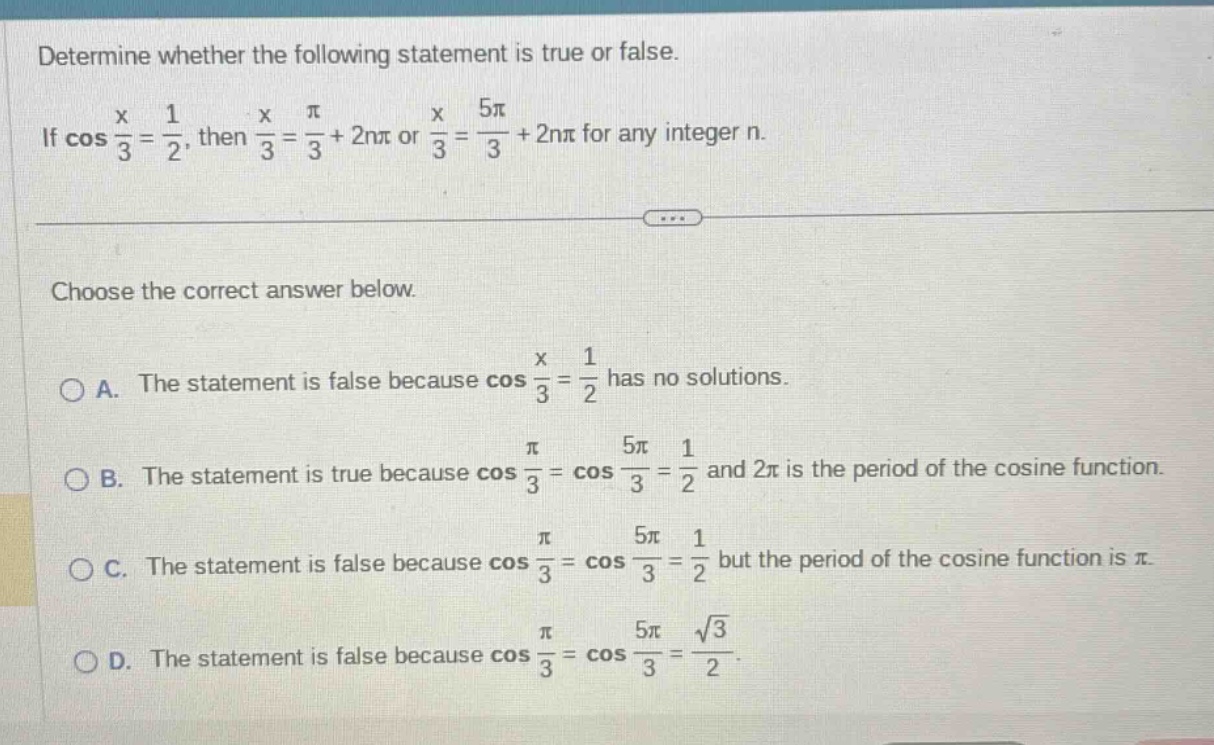
determine whether the following statement is true or false. if cos(x/3)=1/2, then x/3=π/3 + 2nπ or x/3=5π/3 + 2nπ for any integer n. choose the correct answer below. a. the statement is false because cos(x/3)=1/2 has no solutions. b. the statement is true because cos(π/3)=cos(5π/3)=1/2 and 2π is the period of the cosine function. c. the statement is false because cos(π/3)=cos(5π/3)=1/2 but the period of the cosine function is π. d. the statement is false because cos(π/3)=cos(5π/3)=√3/2.
Answer
Explanation:
Step1: Recall cosine - function properties
The general solution of the equation $\cos\theta = a$, where $|a|\leq1$, is given by $\theta=\pm\theta_0 + 2n\pi$, where $\cos\theta_0=a$ and $n\in\mathbb{Z}$. We know that $\cos\frac{\pi}{3}=\frac{1}{2}$ and the period of the cosine function $y = \cos t$ is $T = 2\pi$. If $\cos t=\frac{1}{2}$, then $t=\frac{\pi}{3}+2n\pi$ or $t =-\frac{\pi}{3}+2n\pi$. Since $\cos(-\alpha)=\cos\alpha$, and $-\frac{\pi}{3}+2\pi=\frac{5\pi}{3}$, the general solutions of $\cos t=\frac{1}{2}$ are $t=\frac{\pi}{3}+2n\pi$ or $t=\frac{5\pi}{3}+2n\pi$, $n\in\mathbb{Z}$. Here $t = \frac{x}{3}$.
Step2: Analyze each option
- Option A: $\cos\frac{x}{3}=\frac{1}{2}$ has solutions, so this option is false.
- Option B: We know that $\cos\frac{\pi}{3}=\cos\frac{5\pi}{3}=\frac{1}{2}$ and the period of $y = \cos u$ is $2\pi$. When $\cos\frac{x}{3}=\frac{1}{2}$, $\frac{x}{3}=\frac{\pi}{3}+2n\pi$ or $\frac{x}{3}=\frac{5\pi}{3}+2n\pi$ for $n\in\mathbb{Z}$. This option is true.
- Option C: The period of the cosine - function $y=\cos t$ is $2\pi$, not $\pi$, so this option is false.
- Option D: $\cos\frac{\pi}{3}=\frac{1}{2}$ and $\cos\frac{5\pi}{3}=\frac{1}{2}$, not $\frac{\sqrt{3}}{2}$, so this option is false.
Answer:
B. The statement is true because $\cos\frac{\pi}{3}=\cos\frac{5\pi}{3}=\frac{1}{2}$ and $2\pi$ is the period of the cosine function.