determine whether the following statements are true and give an explanation or counterexample. a. if f(x)>0…
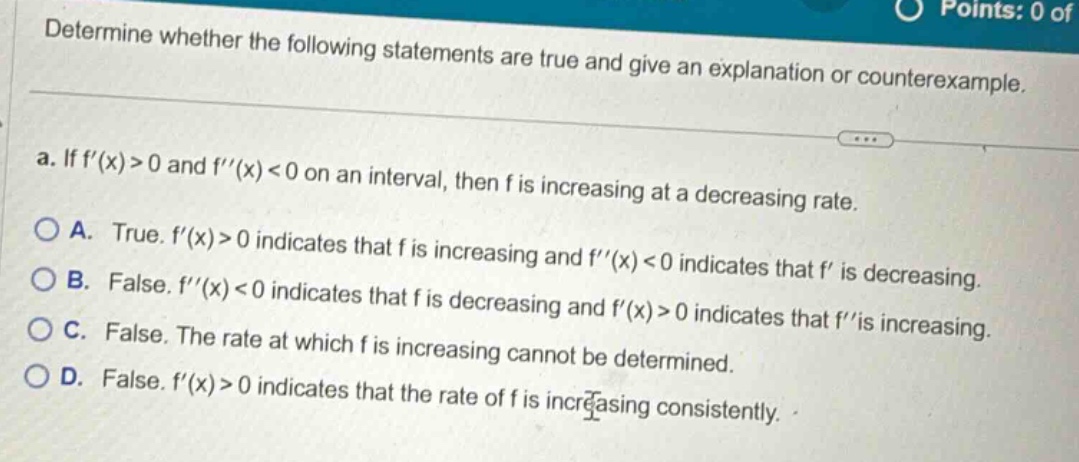
determine whether the following statements are true and give an explanation or counterexample. a. if f(x)>0 and f(x)<0 on an interval, then f is increasing at a decreasing rate. a. true. f(x)>0 indicates that f is increasing and f(x)<0 indicates that f is decreasing. b. false. f(x)<0 indicates that f is decreasing and f(x)>0 indicates that f is increasing. c. false. the rate at which f is increasing cannot be determined. d. false. f(x)>0 indicates that the rate of f is increasing consistently.
Answer
Explanation:
Step1: Recall derivative - related concepts
The first - derivative $f^{\prime}(x)$ represents the rate of change of the function $y = f(x)$. If $f^{\prime}(x)>0$ on an interval, then for any two points $x_1,x_2$ in the interval with $x_1 < x_2$, we have $f(x_2)-f(x_1)>0$, which means the function $f(x)$ is increasing on that interval.
Step2: Recall second - derivative concept
The second - derivative $f^{\prime\prime}(x)$ represents the rate of change of the first - derivative $f^{\prime}(x)$. If $f^{\prime\prime}(x)<0$ on an interval, then the first - derivative $f^{\prime}(x)$ is a decreasing function on that interval. So the rate at which $f(x)$ is increasing (which is given by $f^{\prime}(x)$) is decreasing.
Answer:
A. True. $f^{\prime}(x)>0$ indicates that $f$ is increasing and $f^{\prime\prime}(x)<0$ indicates that $f^{\prime}$ is decreasing.