determine whether the following statements are true and give an explanation or counterexample. a. true…
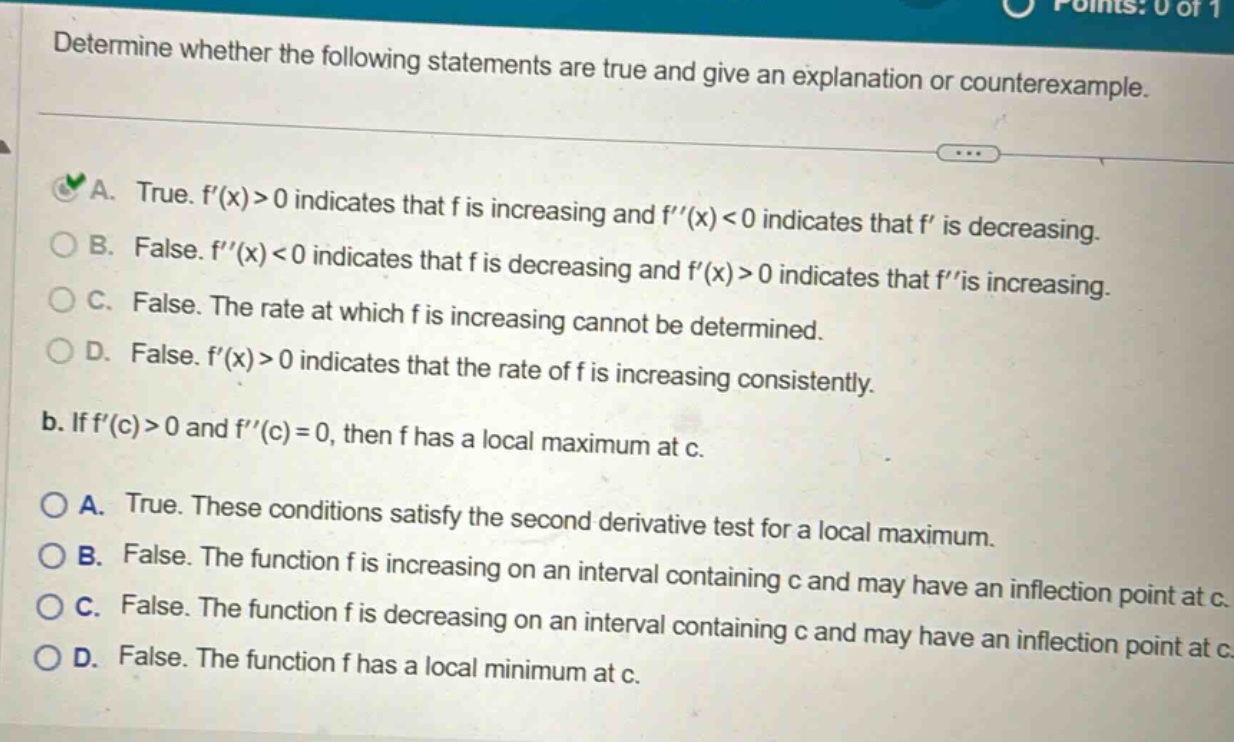
determine whether the following statements are true and give an explanation or counterexample. a. true. f(x)>0 indicates that f is increasing and f(x)<0 indicates that f is decreasing. b. false. f(x)<0 indicates that f is decreasing and f(x)>0 indicates that fis increasing. c. false. the rate at which f is increasing cannot be determined. d. false. f(x)>0 indicates that the rate of f is increasing consistently. b. if f(c)>0 and f(c)=0, then f has a local maximum at c. a. true. these conditions satisfy the second derivative test for a local maximum. b. false. the function f is increasing on an interval containing c and may have an inflection point at c. c. false. the function f is decreasing on an interval containing c and may have an inflection point at c. d. false. the function f has a local minimum at c.
Answer
Explanation:
Step1: Recall derivative - based function behavior rules
If (f^{\prime}(x)>0) on an interval (I), then the function (y = f(x)) is increasing on (I). If (f^{\prime\prime}(x)<0) on an interval (I), then the first - derivative (f^{\prime}(x)) is decreasing on (I).
Step2: Analyze statement a
The statement “(f^{\prime}(x)>0) indicates that (f) is increasing and (f^{\prime\prime}(x)<0) indicates that (f^{\prime}) is decreasing” is True. The first - derivative (f^{\prime}(x)) gives the slope of the function (y = f(x)). A positive (f^{\prime}(x)) means the function is increasing. The second - derivative (f^{\prime\prime}(x)) gives the rate of change of the first - derivative. A negative (f^{\prime\prime}(x)) means (f^{\prime}(x)) is decreasing.
Step3: Recall the second - derivative test for local extrema
The second - derivative test states that if (f^{\prime}(c) = 0) and (f^{\prime\prime}(c)<0), then (f(x)) has a local maximum at (x = c); if (f^{\prime}(c)=0) and (f^{\prime\prime}(c)>0), then (f(x)) has a local minimum at (x = c). If (f^{\prime}(c)>0), the function is increasing at (x = c).
Step4: Analyze statement b
If (f^{\prime}(c)>0) and (f^{\prime\prime}(c)=0), the function (f(x)) is increasing at (x = c) (because (f^{\prime}(c)>0)). A local maximum occurs when (f^{\prime}(x)) changes sign from positive to negative. Since (f^{\prime}(c)>0), (f(x)) cannot have a local maximum at (c). The function (f) is increasing on an interval containing (c) and may have an inflection point at (c) (since (f^{\prime\prime}(c) = 0)).
Answer:
a. A. True. (f^{\prime}(x)>0) indicates that (f) is increasing and (f^{\prime\prime}(x)<0) indicates that (f^{\prime}) is decreasing. b. C. False. The function (f) is increasing on an interval containing (c) and may have an inflection point at (c).